

HRV-guided training beats fixed training plans for one thing in particular: knowing when to back off. Group-level performance gains from HRV guidance alone are small, but combining daily morning RMSSD with resting heart rate and a quick wellbeing check produces real, measurable improvements in endurance output. Start tomorrow morning: take a 1 to 2 minute RMSSD reading, log a 3-item wellbeing score, and compare both against your own rolling baseline before deciding whether today is a hard day.
TL;DR:
- Combining HRV with resting heart rate and wellbeing scores produces more meaningful performance improvements than relying on HRV alone.
- Endurance athletes see clearer benefits from HRV-guided training, while strength athletes should supplement HRV data with performance tests like bar speed or jump height.
- Proper HRV measurement requires consistency in timing, posture, and device, with validation preferred, and baseline data must be established for at least two weeks.
- Reacting to multi-day HRV trends, rather than single-day fluctuations, enables better training planning and avoids unnecessary rest or workload adjustments.
- External factors like travel, poor sleep, or nutrition significantly influence HRV readings, so they must be considered before modifying training based on low scores.
Table of Contents
- What Does the Research Say About HRV-Guided Training for Athletes?
- How Do You Build an HRV-Guided Training Protocol?
- Why Combine HRV With Resting Heart Rate and Wellbeing Scores?
- How Should Athletes Measure HRV Correctly?
- Can Breathing Practice Raise Your HRV Baseline?
- Where Can HRV Data Mislead You?
- What Does a Weekly HRV Monitoring Routine Look Like?
- How Does Nervous-System Training Support HRV Monitoring?
- Do Strength Athletes Need a Different HRV Approach Than Endurance Athletes?
- How Do Travel, Sleep, and Nutrition Affect HRV Readings?
- How Should HRV Data Fit Into a Periodized Training Plan?
- How Much HRV Monitoring Is Actually Necessary?
- Which Trend, Not Which Day, Should Drive Training Changes?
- Who Should Actually Prioritize HRV-Guided Training?
- How Can Alpha Imprinting Complement Your HRV Data?
- Sources
What Does the Research Say About HRV-Guided Training for Athletes?
The honest answer is: it helps, but not as much as the marketing around wearables would have you believe. A systematic review with meta-analysis pooling multiple training studies found that HRV-guided programs reliably raise vagally-mediated HRV indices compared to predefined, calendar-based plans. Those are two very different claims, and the gap between them explains most of the confusion athletes run into.
Group-level effects on VO2max and endurance performance are small and inconsistent across the studies included in that systematic review with meta-analysis, with an effect size around SMD 0.20. That is a real but modest signal, not a guaranteed performance jump. Some of the heterogeneity comes down to athlete level. Well-trained endurance athletes with a lot of room to individualize their week seem to benefit more than mixed-ability groups following a one-size-fits-all comparison plan, and effects also vary by sex and training history in ways the pooled averages tend to flatten out.
Where the picture gets more interesting is when HRV stops working alone and starts working with other signals.
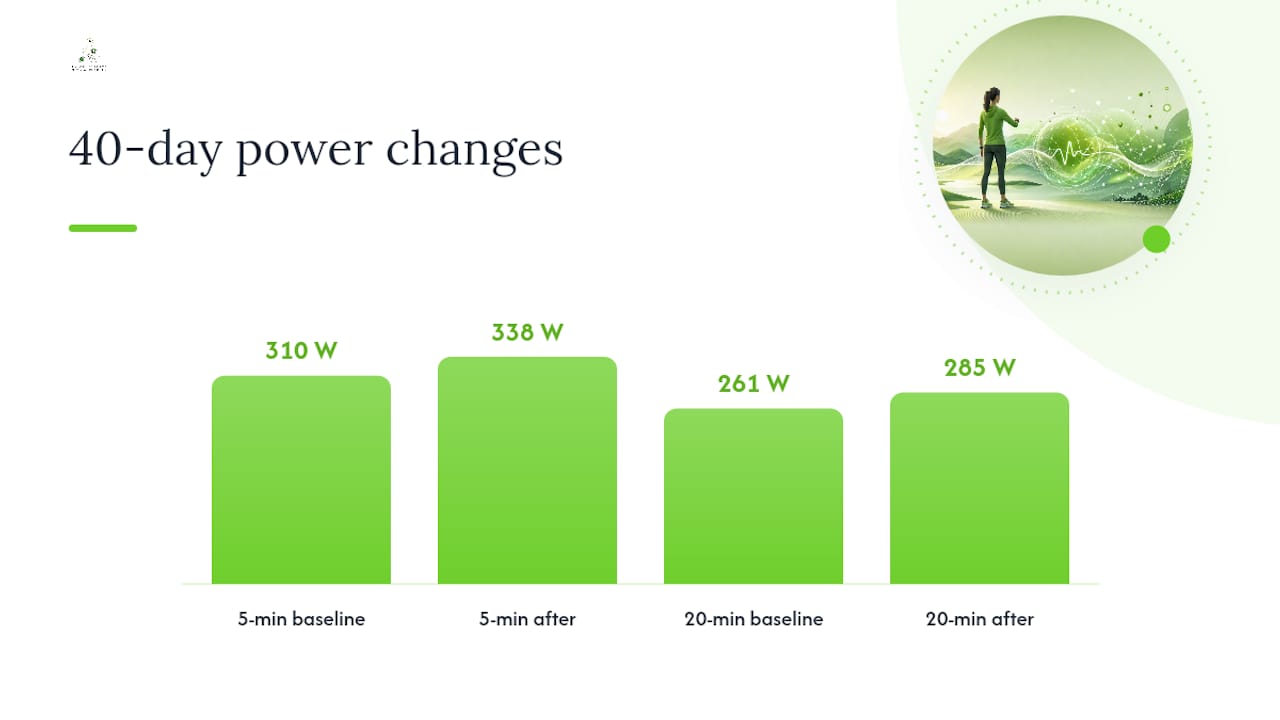
A 40-day study in experienced cyclists compared HRV-only guidance against a group using HRV, resting heart rate, and a short subjective wellbeing score. The combined-metric group produced noticeably larger gains in both short and sustained power output over the 40-day trial, with 5-minute power moving from roughly 310 watts to 338 watts and 20-minute power climbing from about 261 watts to 285 watts. HRV alone did not get athletes as far as HRV paired with two low-effort daily inputs.
Narrative reviews in strength and conditioning back up the caution here. A review on HRV applications in strength and conditioning recommends the baseline-and-smallest-worthwhile-change approach discussed later in this article, but also flags that HRV's utility shifts depending on the sport. It works most consistently in endurance contexts where aerobic load is the dominant training stressor. It gets murkier in strength and power sports, where neuromuscular fatigue doesn't always track cleanly with autonomic markers.
Here's what the evidence supports and doesn't support:
- HRV-guided training raises HRV indices reliably across studies.
- Group-level endurance performance gains from HRV guidance alone are small (SMD ≈ 0.20).
- Adding resting heart rate and wellbeing scores to HRV produces larger real-world performance gains than HRV alone.
- Effects vary meaningfully by athlete level, sex, and sport type. There is no single number that applies to everyone.
- Endurance sports show the clearest, most reproducible benefit signal.
Statistic to remember: the small pooled effect size (SMD ≈ 0.20) on VO2max and endurance performance is not a reason to skip HRV monitoring. It's a reason to stop expecting HRV alone to be your whole recovery system.
How Do You Build an HRV-Guided Training Protocol?
The protocol itself is simple. What trips coaches up is skipping the baseline step and jumping straight to reacting to a single number.
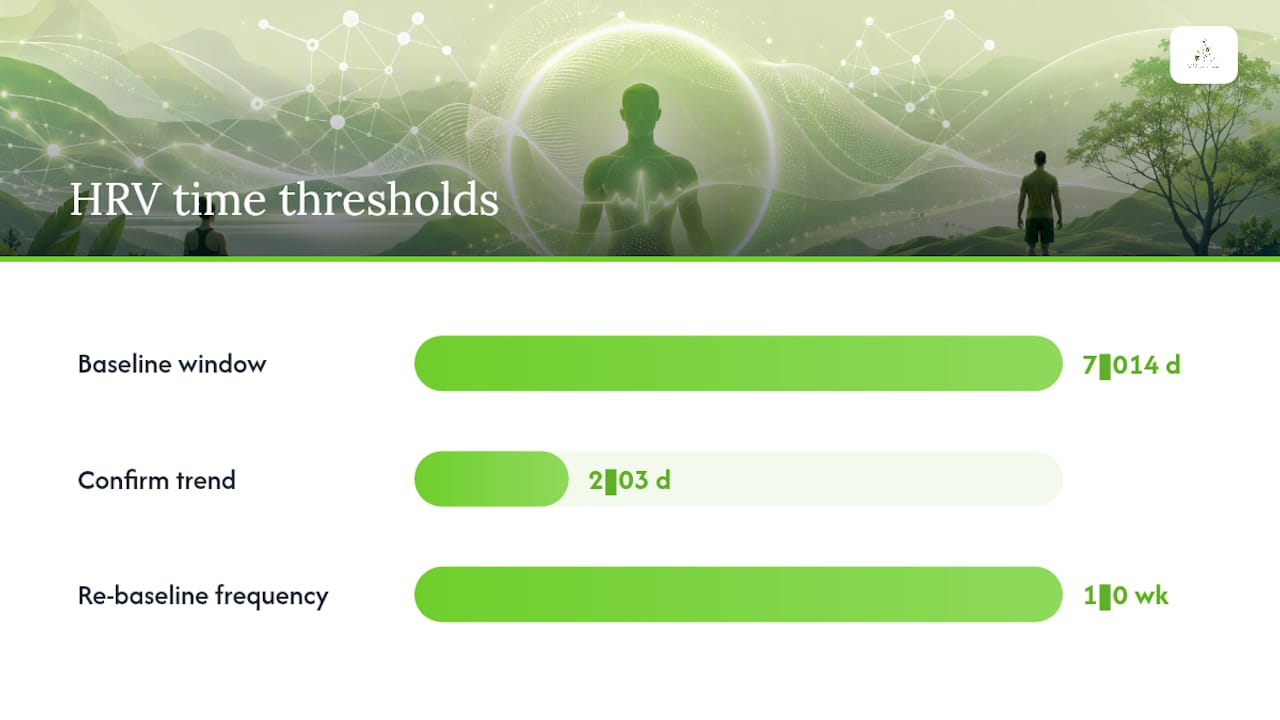
- Collect a baseline first. Record daily morning RMSSD (or its log-transformed version, lnRMSSD, which handles the skewed distribution of raw RMSSD data better statistically) for 7 to 14 days before making any training decisions off it. This is not optional. Reacting to day 3 of a new monitoring habit is reacting to noise.
- Calculate your smallest worthwhile change (SWC). Take the rolling median of that baseline window and compute the standard deviation. A commonly used operational rule treats changes outside roughly 0.5 to 1.0 standard deviations from the rolling baseline as meaningful enough to act on, rather than normal day-to-day fluctuation.
- Apply decision rules based on where today's reading falls. If today's lnRMSSD sits inside your SWC range, train as planned, hard session and all. If it drops slightly below the lower SWC boundary, downgrade the day: swap the planned high-intensity or threshold work for low-intensity aerobic volume or technical work. If it drops well below the SWC (a large deviation, not a marginal one), take the day as recovery or full rest instead of pushing through.
- Re-baseline periodically. Update your rolling median every 1 to 2 weeks as training blocks progress. A baseline built during a taper week will misfire once you're back into a heavy loading phase.
- Log everything in one place. A shared spreadsheet or training app note that both athlete and coach can see removes the guesswork from "why did we change today's session" conversations three weeks later.
The trickiest judgment call is telling a single bad morning apart from a genuine downward trend. One low reading after a poor night's sleep is not the same signal as three consecutive mornings trending down alongside rising resting heart rate. Treat isolated dips as noise until you see at least two to three consecutive days moving in the same direction, and always look at the shape of the trend line, not the number itself.
Documentation matters more than most coaches expect. Athletes who see their own rolling HRV chart alongside the coach's rationale for a schedule change trust the process more than athletes who get told "we're changing today's workout" with no visible reasoning. That transparency is often what keeps buy-in high enough for the monitoring habit to survive past the first two weeks.
Pro Tip: Set your SWC threshold slightly wider during heavy training blocks and slightly tighter during taper. Athletes under high load show more natural HRV suppression that isn't necessarily a red flag, so a wider band avoids false alarms exactly when you need training to keep progressing.
Why Combine HRV With Resting Heart Rate and Wellbeing Scores?
Because HRV by itself produces false positives, and false positives erode trust in the whole system faster than almost anything else. A single depressed HRV reading can come from a bad night of sleep, a stressful email, dehydration, or genuine overreaching. You can't tell which from the number alone.
Resting heart rate acts as a second, largely independent check. When lnRMSSD drops and resting heart rate rises at the same time, that combination is a much stronger signal of accumulated fatigue than either metric alone. When lnRMSSD drops but resting heart rate stays flat, that's often noise, and the cycling study on combined-metric prescription is the clearest applied demonstration of why this combination outperforms HRV-only decision rules.
A 3-item wellbeing scale closes the remaining gap, because it captures things no cardiac measure can see directly.
- Sleep quality rated on a simple 1 to 5 scale, self-reported each morning.
- Muscle soreness, also 1 to 5, tracked at the same time daily for consistency.
- Perceived stress, covering both training and life stress, since a rough week at work or school shows up in recovery capacity just as much as a hard training block does.
Combined decision logic looks like this in practice: HRV down plus resting heart rate up plus poor sleep and high soreness is an easy call. That's a rest day. HRV down but resting heart rate normal and wellbeing scores fine is probably a false alarm. Proceed as planned, or scale back only slightly as a precaution. HRV normal but wellbeing scores tanking (bad sleep, high stress, sore legs) deserves a lighter day even though the cardiac number looks fine. Subjective load doesn't always show up in RMSSD the same morning it happens.
This layered approach costs coaches maybe 90 extra seconds per athlete per day. That's a low price for a meaningfully better signal.
How Should Athletes Measure HRV Correctly?
Bad measurement habits produce bad data, and bad data produces bad training decisions no matter how good your decision rules are. Consistency beats sophistication here.
Take your reading first thing in the morning, before getting out of bed, before coffee, and before any exertion of any kind. Lying supine gives the most stable reading, though seated is acceptable if you use the same posture every single day. A 1 to 2 minute recording window is acceptable for daily RMSSD monitoring in applied settings, though longer recordings up to 5 minutes give slightly more stable numbers if you have the patience for it. Applied coaching guidance from resources like TrainingPeaks reinforces the same core rule: same time, same posture, same conditions, every day, or the trend line means nothing.
Device choice matters more than most athletes assume. A chest strap paired with a validated app gives ECG-quality data, which is the gold standard for HRV accuracy. Validated finger or ear pulse sensors come in a reasonably close second. Wrist-based optical sensors are the most convenient option but the least reliable for HRV specifically, since motion artifact and skin contact issues introduce noise that photoplethysmography struggles to filter out. Use a wrist device if it's genuinely the only thing that will get you to measure consistently, but treat its numbers with a wider margin of error than a chest strap's.
- Log RMSSD or lnRMSSD daily, not just as a mood check.
- Track weekly averages and rolling medians rather than obsessing over single mornings.
- Flag and exclude clearly corrupted readings (movement artifacts, arrhythmic spikes) rather than letting one bad data point drag your baseline around.
- Recheck your baseline whenever you change devices, since different sensors can produce systematically different absolute values even when both are accurate.
Pro Tip: If you travel across time zones or switch devices mid-training block, don't compare new readings to your old baseline. Start a fresh 5 to 7 day mini-baseline first. Cross-device and cross-timezone comparisons are one of the most common sources of false "crashed HRV" panic.
Can Breathing Practice Raise Your HRV Baseline?
Yes, and the effect is well documented enough that it's worth building into a weekly routine rather than treating as an occasional relaxation exercise. Resonance-frequency breathing, sometimes called coherence breathing, means breathing at the specific rate where your heart rate and breathing rhythm sync up most efficiently, typically somewhere between 4.5 and 6.5 breaths per minute. Most people land close to 5.5 breaths per minute, which works out to roughly a 5 to 6 second inhale and a matching exhalation.
Practicing at that resonance frequency for 10 to 20 minutes a day, for 4 to 6 weeks, produces measurable increases in HRV and improved stress resilience, driven by baroreflex sensitivity and respiratory sinus arrhythmia mechanisms. This is not an overnight fix. The timeline matters: expect gradual movement over a full month or more, not a jump after one session.
By the numbers: a daily 10 to 20 minute breathing session, held consistently for 4 to 6 weeks, is the dose associated with measurable HRV gains in the research. Shorter or sporadic sessions haven't shown the same reliable effect.
HRV biofeedback tools, including large consumer datasets like those from HeartMath's Inner Balance platform, show that teaching people to find their own comfortable resonant breathing rate helps them reach higher coherence scores more consistently than generic paced breathing instructions. App-guided sessions work fine for most athletes doing this independently. Practitioner-led biofeedback training is worth the extra structure for athletes dealing with significant performance anxiety or trauma-related autonomic dysregulation, where a coach or practitioner can adjust pacing in real time.
- Practice at your personal resonance frequency, not a generic "slow breathing" pace.
- Do it once daily, ideally at a consistent time, for at least 4 weeks before judging results.
- Pair it with your existing morning HRV check rather than treating it as a separate habit.
Where Can HRV Data Mislead You?
HRV saturation is the trap most experienced endurance athletes eventually hit. Athletes with very high aerobic fitness and already-elevated vagal tone can show a blunted, compressed range of HRV values. There's less room for the number to move, so it becomes a less sensitive tool exactly for the population that relies on it most. This is where resting heart rate and wellbeing scores earn their keep, since they retain sensitivity when HRV itself flattens out.
Device and measurement bias is the second trap. Switching sensors, changing posture, or measuring at inconsistent times can shift your numbers enough to look like a real physiological change when it's actually just measurement noise.
A few other pitfalls worth guarding against:
- Treating one bad morning as a crisis instead of checking for a multi-day trend.
- Comparing your HRV numbers directly to a teammate's. Individual baselines vary enormously and are not comparable across people.
- Ignoring illness, alcohol, or a late night as an obvious explanation before assuming your training load is the problem.
- Using HRV as the only data source when subjective assessment and other physiological markers would catch something HRV misses entirely.
Persistent, multi-week HRV suppression that doesn't respond to reduced load, especially alongside elevated resting heart rate, disrupted sleep, or unusual fatigue, is a red flag that deserves a conversation with a physician, not another week of guessing.
What Does a Weekly HRV Monitoring Routine Look Like?
- Every morning: take your HRV reading, note resting heart rate, log your 3-item wellbeing score, and glance at your rolling trend line before deciding on the day's session.
- Weekly, on a fixed day: review the full week's trend against your SWC threshold, note any two or three-day downward runs, and flag them to your coach or training log before the next hard week starts.
- Every 1 to 2 weeks: update your rolling baseline median so it reflects your current training block rather than a phase you've already moved past.
- Monthly or at block transitions: widen or tighten your SWC band depending on whether you're in heavy loading or taper.
A 4-week sample microcycle might look like this: Week 1 establishes baseline only, no HRV-based adjustments yet. Week 2 introduces decision rules, with one planned high-intensity session swapped for aerobic volume after a two-day HRV dip aligned with poor sleep scores. Week 3 runs mostly as planned, since readings stay inside the SWC band all week. Week 4, a planned deload, sees the SWC band tightened and one extra rest day added after resting heart rate creeps up two mornings in a row.
How Does Nervous-System Training Support HRV Monitoring?
HRV tracks the downstream signal. It doesn't address the upstream cause when that suppressed reading traces back to performance anxiety, an old injury reaction, or a stress response the body never fully resolved. Bottom-up nervous-system training works on that regulation directly, targeting the autonomic patterns that keep showing up as a compressed or unstable HRV baseline no matter how well an athlete manages sleep and load.
Practically, this means pairing structured nervous-system sessions with existing HRV monitoring rather than replacing one with the other.
- Track HRV before and after a block of nervous-system work to see whether baseline shifts upward over weeks.
- Time sessions on days flagged as low-readiness, since that's often when dysregulation is most active.
- Treat HRV data as one input a practitioner reviews alongside behavioral and performance history, not the sole diagnostic tool.
Do Strength Athletes Need a Different HRV Approach Than Endurance Athletes?
Yes, and treating both groups the same is one of the more common mistakes coaches make when they copy an endurance-sport HRV protocol wholesale. Endurance training stresses the aerobic system in a fairly linear, dose-dependent way. More volume and intensity produce a fairly predictable autonomic response, which is exactly why HRV guidance shows its clearest benefits in that context.
Strength and power athletes present a messier picture. Neuromuscular fatigue from heavy resistance work doesn't always show up in autonomic markers the same day, or even the same week, that it shows up in bar speed or jump height. An athlete can have completely normal HRV the morning after a brutal max-effort squat session, because the fatigue sitting in their nervous system is more neuromuscular than autonomic in nature. That doesn't mean HRV is useless for strength athletes. It means it's a weaker, later-arriving signal that works best paired with performance-based readiness checks like bar speed tracking or a quick vertical jump test.
Mixed-sport athletes (think soccer, lacrosse, or tennis players managing both aerobic conditioning and explosive, high-force actions) sit somewhere in between. The practical adjustment: endurance athletes can lean more heavily on HRV-driven decisions for daily intensity calls, while strength and power athletes should treat HRV as a supporting data point behind performance-based readiness testing, not the primary trigger for changing a session.
How Do Travel, Sleep, and Nutrition Affect HRV Readings?
Travel across time zones is one of the biggest, most predictable disruptors of HRV data, and it's also one of the most commonly misread. A dip in HRV the morning after a long flight or a multi-hour time zone shift is jet lag, not overtraining. Give your body 2 to 4 days to adjust before trusting readings against your established baseline, and consider running a short fresh mini-baseline if the trip crosses more than three time zones.
Sleep debt shows up in HRV almost immediately, usually within a single night, which makes it one of the fastest-acting variables in the whole system. A short night before a big event will often suppress next-morning HRV even in an athlete who is training and fueling perfectly. This is exactly why the 3-item wellbeing check matters: it lets you attribute a low reading to sleep rather than jumping straight to "my training load is too high."
Nutrition and hydration status move HRV more subtly but still meaningfully. Under-fueling, alcohol the night before, and dehydration all tend to suppress HRV readings the following morning, sometimes enough to trigger a false "reduce training" signal on a day when the real fix is simply eating and drinking enough.
The practical rule across all three: before you change a training session based on a low HRV reading, run through the obvious explanations first. Did you fly recently? Sleep poorly? Skip dinner or have a drink? If yes, note it in your log and treat that morning's number with appropriate skepticism rather than an automatic downgrade of the day's plan.
How Should HRV Data Fit Into a Periodized Training Plan?
HRV works best as a modifier within a periodized structure, not as the structure itself. The macro plan (base building, build phase, peak, taper) still sets the overall shape of the season. HRV and the metrics that support it decide how individual days and weeks flex within that shape.
During base and build phases, use HRV trends to catch early signs of accumulating fatigue before they turn into a forced, unplanned rest week. A slow downward drift over 10 to 14 days during a heavy loading block is a signal to build in an extra easy day proactively, rather than waiting for performance to actually drop.
During taper and peak phases, HRV serves a different function: confirming that fatigue is clearing on schedule. A rising trend back toward baseline in the final 1 to 2 weeks before competition is a good sign the taper is doing its job. A flat or declining trend during taper is worth a closer look, since it suggests the athlete needs more recovery time than the plan currently allows.
The cleanest integration approach treats HRV, resting heart rate, and wellbeing scores as a daily and weekly layer sitting on top of the periodized plan, adjusting the volume and intensity of individual sessions without touching the broader phase structure unless the trend data is persistent and clear enough to warrant a bigger change.
How Much HRV Monitoring Is Actually Necessary?
Daily morning readings are the standard recommendation, and there's a good reason the applied coaching literature keeps landing on that frequency: HRV is noisy day to day, and you need enough data points to separate a real trend from normal fluctuation. Measuring only two or three times a week makes it much harder to tell the difference.
The good news is that daily doesn't mean burdensome. A 1 to 2 minute recording, taken as part of an existing morning routine, is genuinely all it takes. Athletes who quit HRV monitoring after a few weeks almost always quit because they made it more complicated than it needed to be, not because the data wasn't useful.
For athletes managing multiple stressors (school, work, heavy training volume) a realistic minimum is daily HRV plus RHR for at least 6 to 8 weeks to establish a reliable baseline and see a full training block's worth of trend data. After that initial window, some athletes scale back to 5 or 6 mornings a week during lower-stakes training phases and return to full daily tracking during peak load or competition prep, when the cost of missing a warning sign is highest.
Which Trend, Not Which Day, Should Drive Training Changes?
The single biggest mistake in HRV-guided training is reacting to yesterday's number instead of this month's trend. A rolling 7-day median, updated daily, smooths out the noise enough to show real direction and complements other recovery methods such as the ANF method in sports rehabilitation. Compare that rolling median to your established baseline, not to the previous single morning.
Progressive load adjustment based on trend looks like this: a rolling median trending flat or slightly upward against baseline supports maintaining or slightly increasing load. A rolling median trending downward over 5 or more consecutive days, especially alongside rising resting heart rate, supports a planned reduction in intensity or volume for the coming week, not just a single rest day.
The advantage of trend-based decisions over single-day reactions is that they let you plan ahead instead of scrambling the morning of a session. A coach who sees a downward trend building across a week can restructure the next few days of programming deliberately, swapping a threshold session for tempo work or adding a recovery day in a spot that fits the broader training calendar, rather than making a last-minute call that disrupts the whole week's structure.
Who Should Actually Prioritize HRV-Guided Training?
Endurance athletes managing high, variable training loads get the clearest return here, along with any coach running individualized rather than templated programs. The minimum viable setup is genuinely minimal: a chest strap, a validated app, and 90 seconds a day. Skip expensive platforms until that basic habit sticks for a full month.
Escalate to resonance breathing or biofeedback when HRV stays chronically suppressed despite adequate load management, and escalate to practitioner-led nervous-system work when the pattern looks driven by anxiety or an old trauma response rather than training stress alone.
— Paige
How Can Alpha Imprinting Complement Your HRV Data?
HRV monitoring tells you when your nervous system is under strain. It doesn't fix the underlying pattern driving that strain, and that gap is exactly where Roberts Neurotraining's work picks up. A practitioner-led protocol aims to reprogram stuck stress and trauma responses at the nervous-system level, addressing chronic dysregulation that can appear as a compressed or erratic HRV baseline regardless of sleep, load, and nutrition management.
An initial consultation typically reviews training history, current monitoring data, and possible influences of performance anxiety or past injury on readiness numbers. Subsequent sessions are generally scheduled in relation to the competition calendar and designed to complement existing HRV routines. If you want a self-guided starting point before booking a session, the Energy Optimization Workbook walks through nervous-system regulation practices you can pair directly with your morning HRV check. For athletes ready to work directly with a practitioner, Alpha Imprinting is the place to start.