

Athlete burnout is a psychological syndrome built from three parts: physical and emotional exhaustion, a shrinking sense of accomplishment, and a growing indifference toward the sport once loved. The single most useful first move is triage, not diagnosis: stop adding training load, look honestly at sleep and recovery, and get a physician involved if fatigue or mood changes persist beyond a couple of weeks. Burnout is not a career sentence. With structured rest, the right psychological support, and a coaching environment that backs off rather than pushes through, most athletes recover function and motivation.
TL;DR:
- Most burnout cases require structured rest, psychological support, and a coaching environment that fosters autonomy to recover fully.
- Early intervention, including load management and psychological techniques like mindfulness, reduces recovery time and prevents long-term disengagement.
- Monitoring sleep, resting heart rate, mood, and performance trends over two weeks provides effective early signs of developing burnout.
- Addressing underlying nervous system responses with specialized training can help athletes recover from persistent anxiety and trauma-related blocks.
- Building team programs for burnout awareness and clear referral pathways promotes early detection and intervention, lowering the risk of career-long impacts.
Table of Contents
- What Burnout in Athletes Actually Means
- Why Athletes Burn Out and Who's Most at Risk
- Recognizing the Signs and Knowing When to Get Help
- Building a Burnout-Resistant Training Environment
- How Athletes Recover: Rest, Therapy, and Return to Play
- Simple Ways to Track Burnout Before It Escalates
- Where Nervous-System Training Fits in Burnout Recovery
- The Hidden Cost of Untreated Burnout
- Nutrition and Hydration's Role in Burnout Prevention
- Real Burnout Patterns Coaches and Athletes Should Recognize
- Building a Burnout Awareness Program at the Team Level
- What I Wish More Coaches Understood About Burnout
- Roberts Neurotraining: A Direct Path for Persistent Performance Blocks
- Sources
What Burnout in Athletes Actually Means
Sport psychologists describe athlete burnout as a three-dimensional syndrome, not a single feeling of tiredness. The model, first developed by researchers studying overtrained and disengaged athletes, centers on physical and emotional exhaustion paired with reduced accomplishment and sport devaluation. Exhaustion sits at the middle of the model because it tends to show up first and drives the other two dimensions.
Here's how the three components typically show up on a team or in an individual athlete:
- Exhaustion: chronic physical fatigue that doesn't resolve with a night's sleep, plus emotional depletion that shows up as flatness or short temper.
- Reduced accomplishment: a persistent sense that effort no longer produces results, even when objective performance hasn't dropped much yet.
- Sport devaluation: cynicism or detachment toward practice, competition, or the sport's meaning. An athlete who once lived for game day starts describing it as "just something I do."
Burnout differs from overtraining syndrome in an important way. Overtraining is primarily physiological. It shows up as depressed performance, elevated resting heart rate, hormonal disruption, and slow recovery from workouts, and it usually resolves with a defined rest block. Burnout carries a motivational and affective signature. An athlete can be adequately rested physically and still show the cynicism and devaluation that mark burnout. The overlap is real. Chronic training stress without recovery often produces both conditions at once, which is why coaches sometimes miss the psychological piece while treating the physical one.
The distinction matters for treatment. A physiological overtraining case usually resolves with two to three weeks of load reduction. A burnout case that includes sport devaluation needs a different lever entirely: something that rebuilds meaning and agency, not just glycogen and sleep debt.
Why Athletes Burn Out and Who's Most at Risk
Two forces drive most burnout cases: chronic training stress that outpaces recovery, and a widening gap between the effort an athlete puts in and the reward, recognition, or improvement they get back. The National Athletic Trainers' Association identifies this mismatch, along with staleness, performance stagnation, and loss of enjoyment, as the core pattern behind burnout in competitive sport.
Some athletes carry more baseline risk than others. Longitudinal research consistently points to a specific cluster of vulnerabilities:
- Perfectionistic concerns: athletes preoccupied with avoiding mistakes and fearing others' judgment show measurable increases in burnout risk over a season, according to Frontiers in Psychology's scoping review of longitudinal burnout studies. Interestingly, perfectionistic striving, wanting to be excellent, can actually protect an athlete when it's paired with autonomous motivation rather than fear.
- Early sport specialization: athletes locked into one sport before adolescence lose the recovery benefit of cross-training and often report lower intrinsic enjoyment by their late teens.
- Injury history: a prior injury adds both physical vulnerability and a psychological undercurrent of fear that raises baseline stress load.
- Life transitions: a move to a new team, a coaching change, or a jump from youth to college competition strips away established support systems right when demands increase.
Environmental risk factors matter just as much as individual ones. A controlling coaching style that removes athlete input, chronic travel and schedule overload, and a culture where rest is treated as weakness all raise burnout incidence independent of how resilient the athlete is.
Pro Tip: If you're a coach, ask yourself whether your athletes could explain the reasoning behind this week's training plan. If they can't, you're probably running a controlling rather than autonomy-supportive program, and that gap is a documented risk factor on its own.
Recognizing the Signs and Knowing When to Get Help
Burnout announces itself across four channels, and few athletes show all four at once. Recognizing the pattern early, rather than waiting for a full-blown crash, is what separates a four-week recovery from a four-month one.
- Physical signs: persistent fatigue that doesn't lift with normal rest, elevated resting heart rate, frequent minor illness or injury, and disrupted sleep despite exhaustion.
- Emotional signs: irritability, flatness, apathy toward outcomes that used to matter, and a creeping sense of dread before practice or competition.
- Cognitive signs: trouble concentrating during drills, slower decision making under pressure, and a foggy, disconnected feeling during competition.
- Behavioral signs: skipping optional practices, showing up late, disengaging from teammates, or a noticeable drop in effort during low-stakes moments.
Separating burnout from overtraining syndrome comes down to which channel dominates. If the physical markers (elevated resting heart rate, slow workout recovery, hormonal symptoms) are front and center with little emotional detachment, overtraining is the more likely diagnosis, and it usually resolves with a defined load reduction. If sport devaluation and cynicism are prominent even when physical recovery looks fine, burnout is the better explanation.
Separating burnout from clinical depression is harder and matters more. Burnout is typically domain-specific: an athlete feels flat about their sport but still finds pleasure in other parts of life. Depression tends to spread across every domain, carries more pervasive hopelessness, and often includes changes in appetite or sleep architecture that outlast the competitive season. Any athlete showing persistent low mood, loss of interest across contexts, or thoughts of self-harm needs a referral to a physician or mental health professional immediately. Physical symptoms that don't respond to two to three weeks of reduced training load also warrant a medical work-up to rule out anemia, thyroid dysfunction, or other conditions that mimic burnout.
Building a Burnout-Resistant Training Environment
Prevention works best as a system-level design choice, not an individual willpower problem. Coaches and program directors who build recovery into the season structure see meaningfully lower burnout incidence than those who treat rest as something athletes negotiate for individually.
Training design is the first lever. Periodization, structuring the season into blocks of build, peak, and deliberate recovery, prevents the chronic load accumulation that drives exhaustion. Scheduled breaks matter more than most programs admit: a single unplanned rest day inserted reactively after an athlete is already struggling does far less good than a planned recovery microcycle built into the calendar from day one. Consistent sleep of seven to eight hours nightly is one of the most protective habits available, and early-morning conditioning sessions frequently undercut that threshold without anyone noticing until performance slips.
Coaching climate is the second lever, and it's the one most programs underinvest in:
- Give athletes real input into training decisions, not just the illusion of choice. Autonomy-supportive coaching consistently shows up as protective in longitudinal research.
- Run brief, regular check-ins that ask about energy and motivation, not just performance metrics.
- Build psychological safety so athletes can report fatigue or doubt without fearing it will cost them playing time. Team psychological safety practices give coaches a concrete starting framework.
- Watch for the "pushing through" trap. NATA's guidance notes that treating recovery as optional rather than scheduled is the most common mistake teams make.
Workload monitoring closes the loop. Tracking training volume, intensity, and competition load across a season, rather than reacting only after performance drops, lets coaches catch the climb toward burnout before it becomes a crash. Programs that vary training stimulus year-round, drawing on cross-training and off-season variety the way structured year-round programming recommends, also give athletes a psychological reset that single-sport repetition doesn't provide. Planning genuine off-season time away from structured competition, not just lighter training, is the single most protective calendar decision a program can make.
How Athletes Recover: Rest, Therapy, and Return to Play
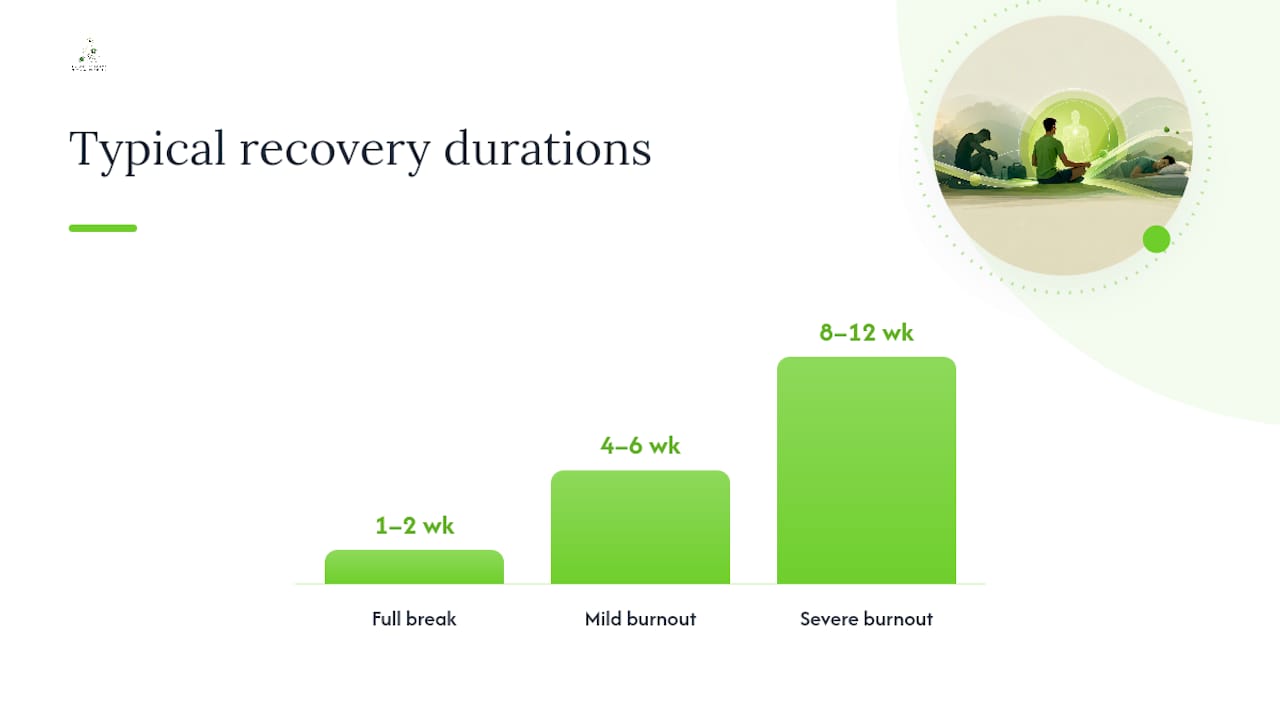
Recovery timelines depend heavily on severity, and setting realistic expectations up front prevents athletes from panicking when week two doesn't feel like a full comeback. Mild burnout typically improves within four to six weeks with reduced training load and improved sleep. Severe or repeated episodes often take two to three months and sometimes longer, particularly when sport devaluation has taken hold and needs active rebuilding rather than passive rest.
Three levels of rest prescription apply depending on severity:
- Full break: a complete pause from organized training, typically one to two weeks, reserved for cases with significant physical exhaustion or early overtraining markers.
- Reduced-load training: cutting volume and intensity by 40 to 60 percent while maintaining light activity, appropriate for moderate cases where full withdrawal would deepen the sense of lost identity.
- Cross-training: substituting a different physical activity for the primary sport, useful for athletes whose devaluation is sport-specific rather than exercise-general.
Rest alone rarely resolves the motivational piece. A systematic review of interventions for youth athletes found that cognitive behavioral therapy, mindfulness-based approaches, and broader sport psychology techniques show real promise for reducing burnout symptoms, and the same body of evidence suggests combining load reduction with psychological skills work, values clarification, flexible goal-setting, mindfulness practice, restores motivation faster than rest by itself and lowers the odds of relapse once training resumes.
A useful benchmark: athletes who combine reduced load with structured psychological intervention tend to show faster restoration of motivation than those who rely on rest alone, according to the same PMC review of youth athlete interventions.
A phased return-to-play plan should be collaborative, involving the athlete, coach, and any treating clinician, rather than dictated from the top down. Build it in stages: symptom-free light training, followed by full-intensity training without competition, followed by graduated competition reintroduction. Watch closely for relapse signs during the second stage especially, since that's where athletes often overestimate their readiness and coaches underestimate how fragile early motivation still is. Nervous-system recovery approaches can complement this staged process by addressing the physiological rebound alongside the behavioral one.
Simple Ways to Track Burnout Before It Escalates
Early detection beats crisis management every time, and the tools for catching burnout early are simpler than most programs assume. Four metrics carry the most signal.
- Sleep hours and quality: a consistent drop below seven hours, or fragmented sleep despite adequate time in bed, is often the earliest warning sign.
- Resting heart rate: an upward drift of five or more beats per minute over baseline, tracked over a week rather than a single morning, flags accumulating physiological stress.
- Mood ratings: a one-to-ten daily self-rating takes fifteen seconds and catches emotional decline weeks before it shows up in performance stats.
- Performance trends: not a single bad session, but a sustained plateau or decline across two or more weeks despite consistent effort.
A workable daily check-in asks three questions: how did you sleep, how's your energy, how's your mood about training today. A weekly trend review then looks back across those seven data points alongside training log data to spot direction, not just snapshots. Repeated measurement across a season matters because burnout is dynamic. An athlete's risk level can shift meaningfully within a single competitive season, and a single point-in-time assessment misses that movement entirely.
When two or more of these markers trend the wrong direction for more than ten to fourteen days, that's the threshold for reducing load rather than waiting for a full crash. Programs that build this review into a weekly coach meeting catch problems earlier than those relying on athletes to self-report distress, which many are reluctant to do until it's already severe.
Where Nervous-System Training Fits in Burnout Recovery
Standard burnout care, rest, load management, and talk-based psychological work, addresses most cases well. But some athletes hit a specific wall: their body has recovered, their schedule has lightened, and they still freeze, overthink, or feel a flood of anxiety the moment competition pressure returns. That's usually a sign the nervous system itself is stuck in a stress response pattern that conventional rest doesn't touch.
Nervous-system training works at a different layer than talk therapy or load management. Rather than working through the narrative of stress, it retrains the automatic physiological pattern underneath it, the reflexive tightening, panic, or shutdown that shows up under pressure regardless of how much an athlete has consciously processed. Robertsneurotraining's Alpha Imprinting protocol was built around this gap, targeting the mental blocks and performance anxiety that persist after standard recovery steps have already been taken.
This approach fits a specific set of scenarios:
- Persistent performance anxiety that doesn't respond to rest or reassurance and shows up as a physical block during competition specifically.
- Trauma-related responses tied to a past injury, where the body still reacts to competitive pressure as if the injury moment is recurring.
- Recovery that has stalled: physical markers look fine, but motivation and confidence haven't returned even after weeks of reduced load.
Nervous-system work is not a replacement for sleep, nutrition, or evidence-based therapy. It complements them. An athlete doing CBT to reframe perfectionistic thinking, sleeping seven-plus hours, and following a phased return-to-play plan can add nervous-system retraining as the layer that addresses the automatic physical response CBT alone sometimes can't reach. Healing sport-related trauma at the nervous-system level explains the mechanism in more depth.
Pro Tip: If an athlete says "I know logically I'm ready, but my body won't cooperate," that gap between knowing and doing is often the clearest sign nervous-system work belongs alongside standard psychological care.
The Hidden Cost of Untreated Burnout
Burnout left untreated rarely stays contained to a single season. It shapes how an athlete relates to competition for years afterward, sometimes for the rest of a career. An athlete who burns out at seventeen and never gets structured support often carries a permanently lowered tolerance for training stress into adulthood, along with a harder time separating self-worth from performance outcomes.
The mental health consequences extend beyond sport. Athletes who experience prolonged sport devaluation without intervention report higher rates of anxiety and low mood that outlast their playing days, since burnout rewires the relationship between effort and reward in ways that don't automatically reset when the season ends. That pattern can resurface in a new job, a new relationship, or any high-pressure pursuit years later.
Career trajectory suffers in a more concrete way too. Athletes who push through burnout instead of addressing it tend to see earlier retirement, more frequent injury (since exhaustion degrades movement quality and decision making), and a compressed prime rather than a full one. The athletes who recover best are usually the ones whose burnout got named and treated early, before sport devaluation hardened into permanent disengagement.
This is the strongest argument for early intervention over toughing it out. A four-to-six-week recovery window addressed promptly costs far less, in performance and in long-term mental health, than a career-altering crash addressed only after everything else has failed.
Nutrition and Hydration's Role in Burnout Prevention
Physical depletion and psychological burnout feed each other, and nutrition is one of the more overlooked levers in that loop. Chronic under-fueling, whether from restrictive eating, poor appetite during high-stress periods, or simply not adjusting intake to match training volume, compounds the exhaustion dimension of burnout directly.
Consistent hydration and adequate caloric intake support the same physiological systems that recovery sleep depends on: hormonal regulation, muscle repair, and the nervous system's ability to downshift out of a stress state after training. An athlete running a caloric deficit during a heavy training block is essentially fighting recovery on two fronts at once, and the emotional flatness that shows up in burnout often gets misread as purely psychological when a nutritional deficit is amplifying it.
Practical steps matter more than perfect precision here. Athletes benefit from eating enough across the full day rather than concentrating intake around single meals, prioritizing protein and carbohydrate replenishment within the recovery window after hard sessions, and treating hydration as a daily baseline rather than something addressed only during competition. Coaches and training staff who screen for under-fueling alongside sleep and mood are catching a variable that pure psychological assessment misses. Nutrition won't resolve sport devaluation or a controlling coaching climate on its own, but it removes one more physiological stressor stacking on top of an already taxed system.

Real Burnout Patterns Coaches and Athletes Should Recognize
Burnout rarely looks like a single dramatic collapse. It usually follows one of a few recognizable patterns that coaches see repeatedly across different sports and levels.
The early specialist who quietly stops caring is one of the most common. A youth athlete pushed into single-sport focus by age ten or eleven often performs well through their mid-teens, then shows a gradual flattening: still technically skilled, but visibly going through the motions. Parents and coaches frequently miss this because performance hasn't dropped yet. Sport devaluation shows up before the numbers do.
The perfectionist who can't tolerate a plateau is another familiar case. An athlete whose identity is built entirely around improvement hits a normal developmental plateau, common in any long-term training arc, and interprets it as personal failure rather than a predictable phase. Without intervention, that misreading accelerates into full exhaustion within a season.
The injured athlete who never fully re-engages illustrates a third pattern. Physical recovery from an injury completes on schedule, but the athlete returns tentative, overthinking movements that used to be automatic. Left unaddressed, that hesitation often calcifies into chronic performance anxiety that outlasts the original injury by years, which is exactly the scenario where combining phased return-to-play with nervous-system-focused work tends to outperform physical rehab alone.
Each pattern responds to early, specific intervention rather than generic rest. Recognizing which one is unfolding is most of the work.
Building a Burnout Awareness Program at the Team Level
Organizations that treat burnout awareness as a formal program, rather than an informal hope that coaches will notice, see better outcomes across a roster. A workable framework has four components.
Start with education before symptoms appear. Coaches, athletic trainers, and team leadership should be able to name the three-dimensional burnout model and distinguish it from ordinary fatigue before the season starts, not after an athlete has already withdrawn. A single preseason briefing covering warning signs takes less than an hour and changes how staff interpret behavior all season.
Build a reporting pathway that doesn't cost the athlete anything. If flagging fatigue or low motivation risks a benching, athletes will hide it. Programs need a clear, low-stakes channel, an athletic trainer, a sport psychology consultant, a confidential check-in, where reporting burnout symptoms doesn't carry a competitive penalty.
Assign clear referral thresholds in advance. Staff should know, before a crisis hits, exactly when a case moves from "coach conversation" to "sport psychology referral" to "medical work-up." Ambiguity here is what causes delayed intervention. Practical in-season strategies for coaches offer a starting structure for building this into an existing program.
Review workload and culture data at the organizational level, not just the individual one. If burnout rates cluster around a particular training block, travel schedule, or coaching style, that's a program design problem, not an athlete resilience problem.
What I Wish More Coaches Understood About Burnout
The biggest mistake I see isn't ignorance about burnout. It's the instinct to treat rest as a reward athletes have to earn rather than a training input they need on schedule. Give athletes explicit permission to rest before they ask for it, and you'll catch burnout at the exhaustion stage instead of the devaluation stage, which is a much easier problem to solve.
Coaches do the most good by responding with curiosity instead of judgment. "What's changed for you lately?" gets further than "You need to push through this." Autonomy matters here too. Athletes who help design their own recovery plan stay more engaged with it than those who receive a prescription.
Team-level support isn't a soft add-on. It's the difference between an athlete who reports fatigue in week three and one who hides it until week twelve. Build the pathway before you need it.
— Paige
Roberts Neurotraining: A Direct Path for Persistent Performance Blocks
When standard rest, load management, and talk therapy haven't fully resolved the performance anxiety or trauma response sitting underneath an athlete's burnout, Alpha Imprinting gives you a next layer to work with. It's Robertsneurotraining's proprietary protocol for retraining the nervous system's automatic stress response, the freeze, panic, or overthinking that persists even after an athlete looks recovered on paper.

Programs run through telehealth sessions, so athletes and coaches anywhere can access 1:1 Performance Neuro Training, the 10-week Energy Optimization Program, or cohort-based group workshops without travel disruption. Sport-specific pages walk through how the protocol applies to tennis, baseball, lacrosse, and equestrian athletes specifically, though the underlying approach applies to any sport where mental blocks are limiting recovery. This fits athletes at any competitive level whose recovery has stalled, not because they're not trying, but because their nervous system is still bracing for the pressure that caused the original block.
If an athlete on your team or in your care has done everything right and still can't shake the anxiety or hesitation, start with the Alpha Imprinting program overview to see how a session works and what the intake process looks like.
This article is general information, not a substitute for advice from a qualified doctor. Consult a qualified healthcare professional about your own circumstances before acting on anything here.
Sources
- Burnout considerations in athletes — NATA
- Burnout and mental interventions among youth athletes — PMC
- Scoping review of longitudinal studies on athlete burnout (Frontiers in Psychology, 2025)