
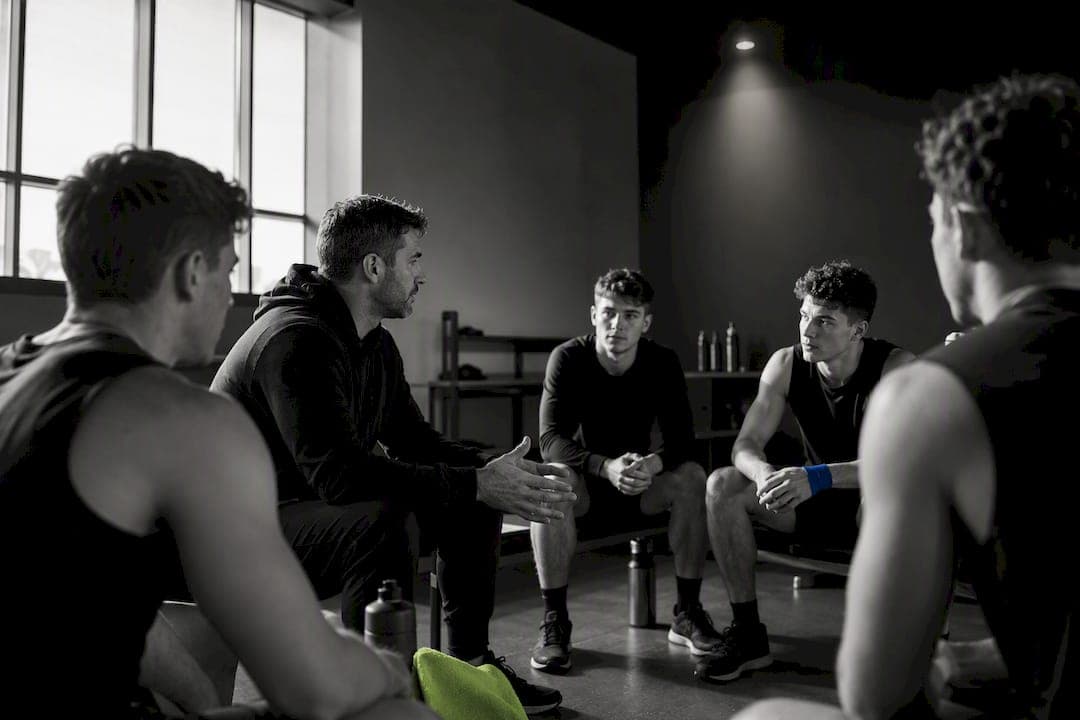
Fixing a toxic sports team culture starts with stopping the harm, not analyzing it. Set clear rules against public shaming and exclusion within the first week, then run a structured, season-long diagnostic across effort, coaching strategy, and group dynamics, and rebuild through psychological safety and an empowered athlete leadership council. Nervous-system training such as Alpha Imprinting can speed recovery once the behavioral groundwork is set.
TL;DR:
- Immediate rules against public shaming and exclusion are crucial to stop ongoing harm within the first week.
- Conduct monthly assessments of effort, inclusion, and exhaustion, adjusting interventions based on the results to prevent regression.
- Rebuilding trust requires consistent evidence of positive change, transparent decision-making, and a clear distinction between performance and character feedback.
- Pair behavioral enforcement with nervous-system work like Alpha Imprinting to address residual anxiety and trauma responses that hinder team cohesion.
- Removing a toxic athlete alone is ineffective; a system-wide approach with peer-led accountability and ongoing evaluation ensures lasting culture change.
Table of Contents
- Triage Checklist: 7 High-Impact Actions For The First 7 to 14 Days
- How Do You Diagnose A Toxic Team Culture?
- What Actually Rebuilds A Broken Team Culture?
- How Does Neuroscience Explain Team Culture Repair?
- What Does A 30 to 90 Day Repair Timeline Look Like?
- How Do You Know The New Culture Is Sticking?
- How Do You Rebuild Trust Between Teammates?
- What Conflict Resolution Actually Works In A Toxic Locker Room?
- Does Diversity Help Or Hurt A Team Recovering From Toxicity?
- How Do You Build Emotional Intelligence Across A Team?
- Why Systems Change And Nervous-System Work Have To Happen Together
- Services That Can Help: Where Roberts Neurotraining Fits
- Further Reading And Primary Sources
- Sources
- FAQ
Triage Checklist: 7 High-Impact Actions For The First 7 to 14 Days
Culture repair fails when coaches try to skip straight to "team building" before the bleeding stops. The first two weeks are about containment, not transformation.
- Set an explicit, spoken rule against public shaming, mocking, or exclusion, effective immediately.
- Establish a temporary communication protocol: how disagreements get raised, and to whom.
- Run private check-ins with athletes and staff who were directly affected.
- Assign one person to document incidents in a central log, dated and factual.
- Offer short-term mental-health referral options and a simple in-team de-escalation step for flare-ups.
- Announce the diagnostic plan and a rough timeline so the team knows change is coming.
- Suspend or remove anyone whose behavior poses an immediate safety risk, without waiting for the full assessment.
Pro Tip: Publicize the first small win, even something as minor as a cleaner locker room or a captain checking in on a teammate. Momentum is built from visible proof that things are actually changing, not from a speech.
The EP Toolkit from the U.S. Center for SafeSport outlines a useful bystander framework here: Distract, Delegate, Document, Delay, Direct. Teach it to captains during this phase.
How Do You Diagnose A Toxic Team Culture?
Guessing what's wrong wastes the early momentum you just built. TrueSport's coach assessment framework breaks the diagnosis into four testable domains:
- Effort — Are athletes showing up mentally, not just physically?
- Skill and ability — Is skill development tracking with expectations, or has stagnation bred resentment?
- Coaching strategy — Are your own decisions read as fair, or arbitrary?
- Group dynamics — Who is included, who is quietly excluded, and who holds informal power?
Pair those ratings with anonymous athlete pulse surveys, staff observation checklists, and simple attendance or engagement tracking. Run this monthly, not once. Research on team-sport burnout found that psychological safety reduced emotional and interpersonal exhaustion over a two-month window, while exhaustion eroded safety within a single month. That reciprocal loop means a quarterly check catches problems months too late.
Use the results to route interventions correctly: an athlete showing rising exhaustion needs individual support, not another team meeting. A pattern of exclusion across multiple athletes points to a group-level fix, and possibly a coaching-strategy adjustment. Diagnosing this well is covered in more depth in our guide to trust and collective athletic performance.
What Actually Rebuilds A Broken Team Culture?
Removing one toxic athlete rarely fixes anything on its own. Without a peer structure holding new norms in place, the same dynamics tend to resurface with a different name attached to them. Rebuilding culture is a system, not a single decision.
- Draft a short team contract covering feedback norms, decision transparency, and what happens when someone breaks the agreement.
- Form a small athlete leadership council, three to five athletes chosen for credibility rather than seniority, and give them real authority to flag issues.
- Re-coach athletes whose behavior is fixable; remove those with a repeated pattern of harm. Consistency matters more than severity here.
- Explain the reasoning behind tough calls, even unpopular ones. Athletes forgive a hard decision far faster than an unexplained one.
- Run short cycles, two to three weeks, aimed at one visible win each, then recognize it publicly.
Research on coach-athlete relationships backs the transparency piece directly: coach behaviors and relationship quality predict psychological safety more reliably than talent management or scheme changes.
Pro Tip: Give the leadership council one concrete decision to own in week one, something small like practice-start rituals. Real authority, even over something minor, builds credibility faster than a title does.
Our breakdown of psychological safety best practices for sports teams covers the contract-drafting process in more detail.
How Does Neuroscience Explain Team Culture Repair?
Team coordination has a measurable neural signature, not just a behavioral one. Research using inter-brain synchrony imaging found that group neural synchrony predicted collective performance better than self-reported team identification or observed behavior alone. A separate hyperscanning study of basketball players found that trained athletic dyads showed stronger interpersonal neural synchronization and higher cooperative behavior than untrained pairs.
The practical read: fear and hypervigilance keep an athlete's nervous system locked in threat mode, and a brain stuck there cannot synchronize with teammates no matter how good the game plan is. Behavioral fixes lower the threat. Nervous-system work addresses what's left over, the anxiety and trauma responses still firing after the rules have changed.
Psychological safety appears to be a precondition for neural coordination, not a byproduct of it. Teams have to feel safe before their brains can actually get in sync.
Practical integrations coaches can trial without overhauling a season:
- Short pre-game nervous-system resets for athletes carrying performance anxiety.
- Group Alpha Imprinting workshops timed after the behavioral triage phase, not instead of it.
- QEEG-guided follow-ups for athletes showing persistent trauma responses or stalled recovery despite behavioral change.
More on the mechanics is in our guide to enhancing team cohesion through neuroscience.
What Does A 30 to 90 Day Repair Timeline Look Like?
Culture repair collapses when it has no gates, just good intentions that fade by week three. A phased structure with decision points keeps everyone accountable, including the coach.
- Days 0 to 14: Triage. Stop harmful behavior, announce the diagnostic, set interim communication norms and an incident log.
- Weeks 3 to 6: Run the four-domain assessment, form the athlete leadership council, and decide who gets re-coached versus removed.
- Weeks 7 to 12: Formalize the team contract, run regular pulse checks, and pilot a nervous-system intervention with athletes showing persistent exhaustion.
Decision gates matter here. The coach owns behavioral enforcement and day-to-day norms. The athletic director signs off on removals and any budget for outside specialists. Athlete leaders own peer accountability. Refer to a specialist, whether a mental-health provider or a nervous-system practitioner, the moment exhaustion or trauma responses persist past week six despite consistent behavioral change. Our team mental training program guide walks through pilot design in more detail.
How Do You Know The New Culture Is Sticking?
Repair without measurement quietly reverts. Track five things monthly: a psychological-safety pulse score, incident counts from the log, attendance or engagement rates, athlete-reported exhaustion, and whatever performance indicators matter for your sport.
- Run the monthly check as a short anonymous survey plus a five-minute staff rating session, logged in one shared sheet.
- Escalate immediately if athlete-reported exhaustion climbs two months running or an exclusion incident repeats.
- Watch for the leadership council losing credibility, athletes stop bringing issues to them, which usually means the council needs new members, not more meetings.
The reciprocal exhaustion-safety loop documented in team-sport burnout research is the reason monthly, not quarterly, is the right cadence. Bring in outside specialists when the dashboard shows two consecutive red months rather than waiting for a crisis.
How Do You Rebuild Trust Between Teammates?
Trust rebuilds through small, repeated proof, not a single conversation. Athletes who've been burned by a toxic culture don't believe words; they believe patterns held over weeks.
Start with structured check-ins rather than open floor time. A round robin where every athlete gets thirty seconds, no interruptions, no rebuttals removes the loudest voices' usual advantage and gives quieter athletes room to be heard. Follow every team decision with a one-line explanation of the reasoning. Athletes don't need to agree with a call. They need to know it wasn't arbitrary.
Feedback needs a stated channel, not an implied one. Decide explicitly whether concerns go to the captain, an assistant coach, or an anonymous form, and stick to that channel even when it's inconvenient. Ambiguity about where complaints go is exactly how toxic cultures re-form: issues go underground, get discussed in side conversations, and calcify into cliques.
Transparency about mistakes from coaching staff carries outsized weight. Admitting a bad rotation decision or a miscommunicated schedule change publicly does more for trust than any amount of praise. Athletes calibrate trust based on whether leadership owns its own errors, not just theirs.
Finally, separate performance feedback from character feedback in every conversation. "That read was late" rebuilds skill. "You're not a team player" rebuilds nothing and reopens old wounds. The distinction sounds small. In a team that's already been burned by public shaming, it's the difference between a correction landing as coaching and landing as another attack.
What Conflict Resolution Actually Works In A Toxic Locker Room?
Standard conflict resolution assumes goodwill on both sides. Toxic environments often don't have that yet, so the technique has to change.
Separate the incident from the pattern first. A single sharp exchange after a tough loss is different from a teammate who's excluded the same athlete for three straight months. Treat them differently. The first needs a cooling-off period and a brief mediated conversation. The second needs documentation, a direct conversation about the pattern, and a clear consequence if it continues.
Mediate one-on-one before bringing conflicts to the full group. Group confrontations in a toxic culture tend to turn into public trials, with bystanders picking sides rather than resolving anything. A private conversation, ideally with a neutral captain or assistant coach present, lets both athletes speak without an audience shaping their words.
Use a simple structure for the mediated conversation: each athlete states what happened from their side without interruption, then states what they need going forward. Skip the "why did you do that" framing entirely. It invites defensiveness. "What do you need from your teammate now" moves the conversation toward resolution instead of relitigating blame.
Document every mediated conflict in the same incident log from the triage phase, even resolved ones. A pattern invisible in any single incident often becomes obvious across five logged entries. If the same two names keep appearing, the issue isn't personality, it's structural, and probably points back to unclear roles or coaching favoritism worth examining directly.
Does Diversity Help Or Hurt A Team Recovering From Toxicity?
Diverse teams recovering from a toxic culture face a real fork: diversity of background and perspective can either accelerate repair or, if handled carelessly, become the next fault line the old cliques exploit.
The upside is real. Teams with a wider range of backgrounds tend to surface more perspectives on what's actually broken, since athletes notice different things depending on their position, seniority, and life experience outside the sport. A toxic culture often blinds insiders to problems that an athlete from a different background spots immediately, whether that's a double standard in playing time or a joke that reads as harmless to some and corrosive to others.
The risk shows up when inclusion becomes a talking point instead of a practice. Adding diverse athletes to a roster without changing who holds informal power just gives the old hierarchy new people to exclude. The athlete leadership council has to reflect the roster's actual composition, not just its most vocal or senior members, or it inherits the same blind spots that caused the original culture problem.
Practically, this means building feedback channels that don't require confronting the group's dominant personalities directly. Anonymous pulse surveys matter more on a diverse roster recovering from toxicity, since athletes who are newer to the group or outside its informal power structure are least likely to speak up in open settings. Watch the survey data by subgroup, not just in aggregate, if patterns of exclusion are breaking along any predictable line. That single check catches problems a team-wide average will hide.
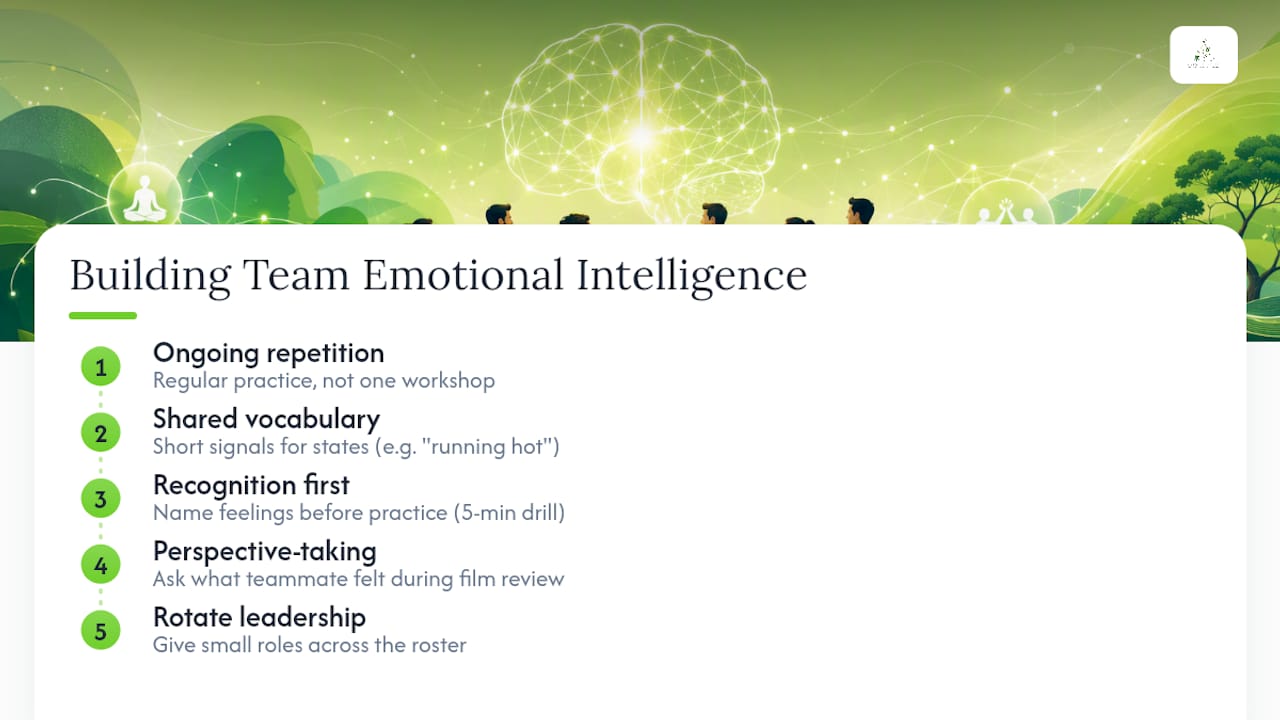
How Do You Build Emotional Intelligence Across A Team?
Emotional intelligence training works best as ongoing repetition, not a one-time workshop that everyone forgets by the next road trip.
Start with a shared vocabulary for emotional states. Athletes need a fast, low-stakes way to say "I'm running hot" or "I'm checked out today" without it becoming a big confession. Teams that build this language into daily check-ins catch problems while they're still small, before frustration turns into the kind of public conflict that damaged the culture in the first place.
Teach recognition before regulation. Most athletes can't manage an emotion they haven't identified. A five-minute drill where athletes name what they're feeling before practice, out loud or on a card, builds the recognition muscle that regulation depends on later.
Build perspective-taking into film review. When reviewing a missed assignment or a blown coverage, ask what the teammate involved might have been thinking or feeling in that moment, not just what the mistake was technically. This does double duty: it improves tactical understanding and builds the habit of reading teammates as people, not just performers.
Rotate small leadership responsibilities through the full roster over a season, not just to the same three captains. Running a warmup, leading a debrief, or checking in on an injured teammate builds the empathy and self-awareness that formal leadership roles are supposed to develop, and it spreads emotional intelligence development across the group rather than concentrating it in a few athletes who already had it. Our guide on shared mental models in sports covers how to structure this rotation without disrupting your existing depth chart.
Why Systems Change And Nervous-System Work Have To Happen Together
Coaches have to lead the behavioral rebuild. No nervous-system protocol replaces clear rules, honest conversations, and consistent enforcement, and pretending otherwise sets teams up for a relapse the moment the novelty of a new intervention wears off.
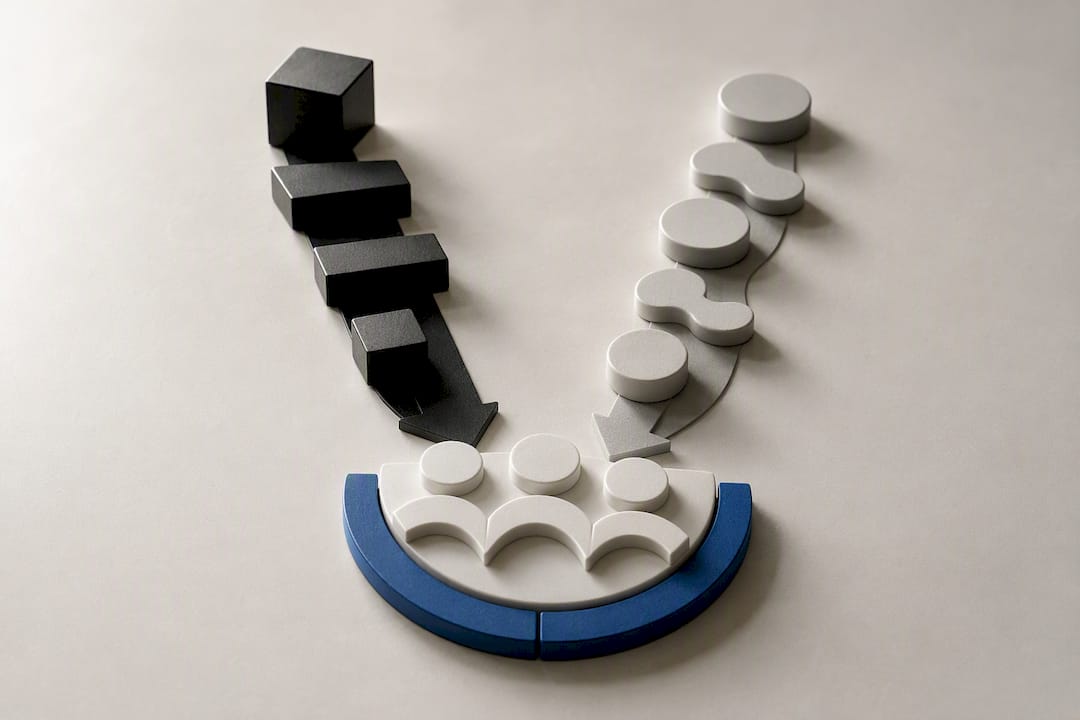
What the nervous-system layer adds is speed. Teams that combine consistent behavioral standards with structured psychological safety practices tend to see steadier engagement over a season than teams relying on rule changes alone, matching what the autonomous motivation research suggests about safety driving engagement indirectly through motivation. Adding a nervous-system component on top of that foundation, rather than instead of it, is where recovery compounds instead of plateauing.
The honest version of this work is unglamorous. It's documentation, consistent enforcement, and monthly pulse checks, with nervous-system training in a supporting role, not the headline. Teams and coaches serious about this shift can reach out to discuss a team evaluation or pilot session.
— Paige
Services That Can Help: Where Roberts Neurotraining Fits
This type of nervous-system focused training can support teams that have already done the behavioral rebuild but still see athletes stuck in performance anxiety, trauma responses, or persistent exhaustion that team rules alone can't touch. Where a standard sports psychologist offers talk-based coping strategies, Dr. Paige Roberts works directly at the nervous-system level, using a proprietary protocol built on more than 21 years of work with Olympic and professional athletes.
For teams, the Group & Team Alpha Imprinting program targets shared performance anxiety and trauma responses that keep a roster from reaching collective flow, even after culture repairs are underway. The 12-Week Energy Optimization Program supports individual athletes carrying the heaviest exhaustion load from the diagnostic phase. QEEG brain scans give coaches objective, follow-up data on whether an athlete's nervous system is actually recovering, rather than relying on self-report alone.
If your team has run the behavioral playbook and progress has stalled, book a consult through the services page to talk through whether a group session or an individual pilot fits your roster.
Further Reading And Primary Sources
- Inter-brain synchrony and team performance
- TrueSport's coach guide to team culture
- Burnout prevention in male team sport
- Team psychological safety best practices
- Catch athlete burnout early
Sources
- Inter-brain synchrony and team performance (PMC article)
- A Guide for Coaches Who Want More Effective Team Culture (TrueSport)
- Burnout prevention in male team sport: reciprocal associations with psychological safety
- Psychological safety and athlete engagement in team sports (BMC Psychology)
FAQ
How Long Does It Take To Fix A Toxic Team Culture?
Most teams see measurable shifts in psychological-safety scores within a two-month window of consistent effort, based on the reciprocal exhaustion-safety pattern tracked in team-sport research. Full culture change, including sustained trust and leadership credibility, typically takes several months of monthly monitoring.
Should You Remove A Toxic Athlete Immediately?
Remove or suspend an athlete right away only when safety is at risk; otherwise, pair the decision with a broader fix. Removing one person without building peer accountability through an athlete leadership council usually leaves the underlying group dynamics unchanged.
What Is The First Sign A Team Culture Is Improving?
Rising engagement in anonymous pulse surveys and a drop in logged incidents are the earliest reliable signals, often visible within the first month of consistent enforcement. Public recognition of small positive behavior changes tends to accelerate this shift by building visible momentum.
Can Neuroscience Really Help With Team Culture Problems?
Neuroscience-based tools like Alpha Imprinting address performance anxiety and trauma responses that behavioral rule changes alone don't reach. Research on inter-brain synchrony shows that neural coordination between teammates predicts performance, and reducing individual threat responses helps that coordination happen.
How Much Does Team-Focused Nervous-System Training Cost?
Group & Team Alpha Imprinting through Robertsneurotraining is priced at 4500 USD as a one-time program, listed on the services page. QEEG brain scans, listed separately, run 1500 USD per scan.