
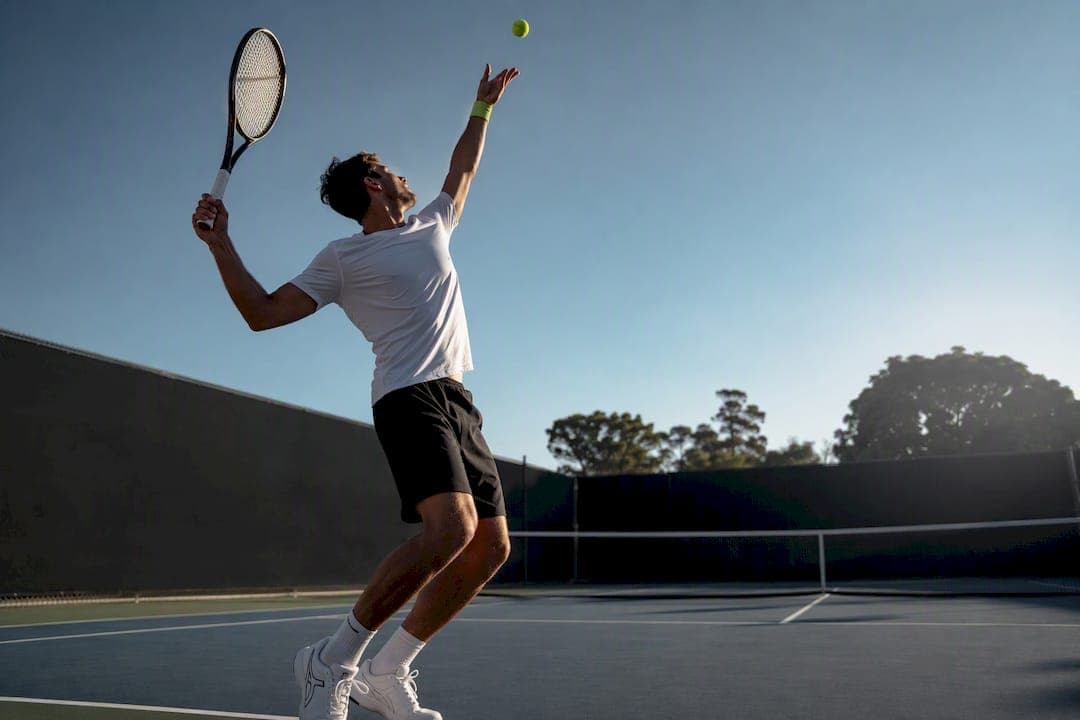
Flow is the state of total absorption where action and awareness merge, self-consciousness drops away, and performance often feels effortless even under pressure. It matters because flow correlates with meaningfully better athletic output, and unlike raw talent, it can be trained through specific conditions and practice, even though no athlete can force it into existence on command.
TL;DR:
- Athletes should focus on balancing challenge and skill, setting specific micro-goals, and ensuring immediate feedback to more effectively enter flow states.
- Recognizing perceptual, bodily, and cognitive signals of flow, such as time distortion and automatic movement, helps athletes train for better, more consistent performance.
- Structured flow training over 10 to 12 weeks, including baseline measurement, initiation, extension, and recovery phases, can measurably improve flow access.
- Short pre-performance routines involving breathing, visualization, and cue triggers significantly increase the likelihood of entering flow during competition.
- Combining mindfulness, visualization, and occasional neurotraining for unresolved nervous system issues enhances flow capacity, especially in athletes with past trauma or high anxiety.
Table of Contents
- What Is the Flow State in Sports? Definition, History, and Core Characteristics
- What Flow Feels Like in Practice (With Sport-Specific Examples)
- How Strong Is the Evidence Linking Flow to Sports Performance?
- What Conditions Increase the Chance of Entering Flow?
- How to Train Flow Capacity: A 10 to 12 Week Framework
- Pre-Performance Routine and Trigger Checklist for Flow
- Do Mindfulness and Meditation Actually Support Flow?
- Performance Neuro Training: An Advanced Option When Flow Stays Out of Reach
- Training Flow as a Capacity, Not a Miracle
- Sources
What Is the Flow State in Sports? Definition, History, and Core Characteristics
Psychologist Mihaly Csikszentmihalyi coined the term in the 1970s after studying artists, surgeons, and rock climbers who described losing track of time while working at the edge of their ability. He called it flow because his subjects kept using that exact word, describing a current that carried them through the task rather than one they had to push against. Sports psychology adopted the concept almost immediately, since the "in the zone" language athletes had used for decades matched Csikszentmihalyi's model almost perfectly.
The original research identified nine characteristics of flow, but athletes and coaches only need to track a handful of them in real time. The big ones: total absorption in the task, a sense of effortlessness even during hard physical work, distorted time perception (seconds stretching or minutes vanishing), clear moment-to-moment goals, and immediate feedback on whether an action worked. A basketball player who can't remember taking a shot but watches it swish through the net is experiencing exactly this cluster.
Here's the distinction that trips up a lot of training advice: some of those nine characteristics are antecedents (conditions that make flow more likely) and some are experiential dimensions (what flow feels like once you're in it). Challenge-skill balance and clear goals are antecedents. You can build them into practice. Time distortion and loss of self-consciousness are experiences that show up as a result. You cannot practice "losing self-consciousness" directly. You can only build the conditions that tend to produce it.
This distinction is the whole reason flow state training works instead of being wishful thinking. Athletes and coaches who understand it stop chasing the feeling and start engineering the conditions. That's a fundamentally different, more reliable approach to achieving flow in sports, and it's the model this article builds on. Applied guidance from the Association for Applied Sport Psychology reinforces the same point: clear goals, balanced challenge, and structured routines are the levers athletes actually control.
One more piece of the definition matters for training purposes. Flow sits on a continuum, not a binary switch. Athletes can be partially absorbed, mostly absorbed, or fully immersed, and most competitive performance happens somewhere in the middle of that range rather than at the extreme "peak experience" end that gets all the attention in highlight reels.
What Flow Feels Like in Practice (With Sport-Specific Examples)
Flow shows up through three overlapping sets of signals: perceptual, bodily, and cognitive. Recognizing them in the moment is a skill of its own, and it's the first thing athletes need before they can train toward the state deliberately.
- Perceptual markers: time slows down or disappears, peripheral distractions fade, and attention narrows onto the ball, the opponent, or the next two feet of trail.
- Bodily markers: movement feels automatic rather than deliberate, breathing settles into rhythm, and there's a felt sense of "the body knows what to do."
- Cognitive markers: internal commentary goes quiet, self-doubt disappears, and decisions happen faster than conscious thought can track.
A basketball player in a shooting flow describes the rim looking larger and the ball leaving their hand before they've consciously decided to release it. A sprinter coming out of the blocks in flow reports the start gun sounding distant, almost delayed, while their own first three steps feel like they're happening to someone else. A golfer over a critical putt in flow loses the surrounding gallery entirely. Their whole perceptual field narrows to the line between the ball and the hole, and the stroke happens smoothly with none of the jerky overcorrection that shows up when self-consciousness creeps back in.
Flow has an entry point, a maintenance phase, and an exit, and athletes benefit from noticing all three rather than assuming it's an on/off state. Entry usually follows a specific trigger such as the first clean rep, the first made shot, or a well-executed opening sequence. Maintenance depends on continuous, immediate feedback: each swing, pass, or stride either confirms the state or starts pulling the athlete out of it. Exit tends to happen fast, often triggered by an external interruption (a whistle, an injury scare, a bad call) or an internal one (a stray thought about the scoreboard or the crowd). Qualitative research on elite college athletes and musicians backs this staged model directly, describing preparation, entry, and exit as distinct phases where emotional regulation and bodily awareness matter as much as pure cognitive focus.
How Strong Is the Evidence Linking Flow to Sports Performance?
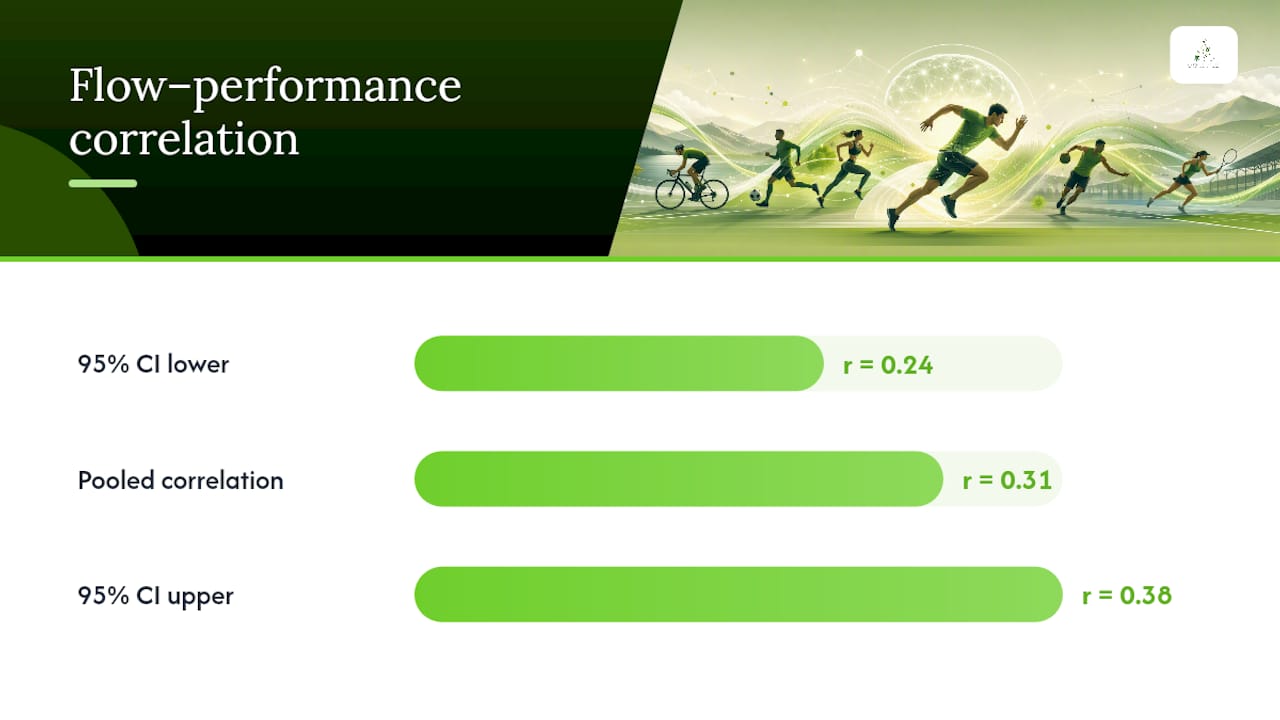
The strongest number in flow research is a pooled correlation of r = 0.31, drawn from a 2021 meta-analysis of 22 separate studies with a 95% confidence interval of [0.24, 0.38].
The Data Point That Matters: A 2021 systematic review pooling 22 studies found a medium-sized positive relationship between flow and athletic performance (r = 0.31). That's not a weak signal, and it's not proof that flow guarantees a personal best either. It sits squarely in the range researchers classify as a genuine, replicable, moderate effect.
Translated into practical terms: athletes who report higher flow tend to perform better, and the relationship holds across a range of sports and skill levels, but flow shares the stage with technical skill, physical conditioning, tactical preparation, and plain luck. No study claims flow alone explains most of the variance in outcome. It's one lever among several, and it's a lever athletes can actually pull, which is more than can be said for genetics or the weather.
Beyond the meta-analysis, phenomenological studies add texture the numbers can't. Qualitative work on elite athletes and musicians consistently describes three phases: preparation (the mental and physical setup before competition), entry (the specific moment absorption takes hold), and exit (the moment it breaks). Emotions and bodily awareness show up as central across every phase in that research, not as background noise. This matters for training because it means flow work can't be purely cognitive. Breathing, posture, and felt emotional tone are doing real work, not just decoration around the "real" mental skill.
The neuroscience side of the story is where things get genuinely contested. One camp argues flow involves focused, high-attention states, meaning task-relevant brain networks ramp up and coordinate tightly. Another camp points to hypofrontality, the transient quieting of prefrontal cortex regions associated with self-monitoring and deliberate control, as the mechanism behind the loss of self-consciousness and effortless feel. Recent neuroimaging coverage out of Drexel University frames this as an active, unresolved debate rather than a settled question, and both models likely capture part of a more complicated picture.
Here's how to reconcile that for training purposes without waiting for neuroscience to agree with itself:
- If focused attention drives flow, attention training (sustained concentration drills, narrowing and widening focus deliberately) should help.
- If hypofrontality drives flow, then reducing conscious self-monitoring, through overlearned skills and external focus cues, should help.
- Both models point toward the same practical answer: overtrain the skill until it doesn't need conscious supervision, then train attention to stay locked on task-relevant cues.
The honest limitation here: most flow research relies on self-report questionnaires collected after the fact, which introduces recall bias and makes it hard to establish causality. Does flow cause better performance, or does performing well retroactively make an athlete feel like they were "in the zone"? The Flow Research Collective's neuroscience summaries describe flow as efficient, flexible coordination across brain systems, which is a compelling model, but measurement heterogeneity across studies means comparing results directly remains genuinely difficult.
What Conditions Increase the Chance of Entering Flow?
Flow doesn't arrive at random. Specific, controllable conditions raise the odds substantially, and athletes who arrange them deliberately report entering flow more often than those who wait for it to happen.
- Balance challenge against skill. Flow lives in a narrow band where the task is hard enough to demand full attention but not so hard it triggers anxiety. Too easy produces boredom; too hard produces panic. Adjust drill difficulty, opponent selection, or target distance until the task sits right at the edge of current ability.
- Set clear, immediate micro-goals. Vague intentions like "play well" don't give the brain anything to lock onto. Specific in-the-moment targets, hit this line, close this gap, execute this footwork pattern, give attention a concrete anchor.
- Build in fast, direct feedback. Flow depends on knowing instantly whether an action worked. Sports with built-in feedback loops (a made shot, a clean pass, a stopwatch split) make flow easier to sustain than sports where results take longer to show up.
- Manage arousal instead of suppressing it. Nervous energy isn't the enemy. The goal is channeling it into functional intensity rather than flattening it into calm, which often kills the sharpness flow requires. Emotional regulation strategies that redirect adrenaline into controlled aggression tend to outperform pure relaxation techniques for this reason.
- Run consistent preparation behaviors. Warm-up routines, equipment checks, and pre-performance rituals aren't superstition. They reduce the cognitive load spent on setup so more attention is available for the task itself.
- Track your own patterns over time. Motivation, perceived control, and sheer practice history all shift how easily an individual athlete accesses flow. What works for a teammate may not transfer directly, so personal pattern recognition across a season matters more than any generic checklist.
How to Train Flow Capacity: A 10 to 12 Week Framework
Flow capacity behaves like any trainable physical quality: it responds to structured, progressive practice rather than to hoping the right mood strikes on game day. Practitioner frameworks describing flow as a skill built through attention and timing practice rather than a gift some athletes simply have align with what the intervention research shows: structured programs can measurably shift how often and how deeply athletes access the state, even though results across studies remain mixed.
Here's a four-block structure spread across 10 to 12 weeks that turns the research into something an athlete or coach can actually run.
- Weeks 1 to 2: Baseline measurement. Before changing anything, log three numbers after every practice session: entry latency (how many minutes into the session before you notice absorption starting), sustained duration (how many minutes it lasted), and recovery time (how long it took to re-enter flow after an interruption like a missed rep or a coaching correction). This baseline is the only way to know later whether training is working, and most athletes are surprised by how inconsistent their numbers look in week one.
- Weeks 3 to 5: Initiation training. Focus drills on deliberately triggering entry using a consistent cue, a breath pattern, a physical anchor movement, or a specific self-talk phrase, repeated at the start of each session until it reliably shortens entry latency. This is where attention training earns its name: short bursts of sustained, narrow focus (60 to 90 seconds building to 3 to 5 minutes) practiced daily, separate from sport-specific drills, strengthens the same attentional control that flow entry depends on.
- Weeks 6 to 8: Extension training. Once entry becomes reliable, the goal shifts to duration. Extend practice segments that historically triggered flow by small increments, and deliberately introduce process-absorption drills, tasks where the athlete focuses entirely on execution quality rather than outcome, which tend to sustain the state longer than outcome-focused reps.
- Weeks 9 to 12: Recovery and robustness. This block trains the skill most programs skip entirely: recovering from interruption. Deliberately introduce controlled disruptions mid drill (a whistle, a bad call simulation, a crowd noise recording) and practice re-entering flow afterward. Varying training environments (different courts, lighting, noise levels, opponents) during this block builds robustness so flow doesn't depend on one narrow set of ideal conditions.
Timing itself is worth training directly. Sport psychology sometimes borrows the Greek distinction between chronos (clock time) and kairos (the right or opportune moment), and elite performers often describe flow entry as recognizing a kairos moment rather than watching a clock. Drills that reward recognizing the "right instant" to commit to an action, a passing lane, a swing timing, a break in an opponent's rhythm, build this sense of timing more directly than generic reaction-time work.
Pro Tip: Keep a simple weekly rolling average of your three logged metrics instead of judging any single session. Flow entry latency naturally bounces around day to day based on sleep, stress, and prior workload. The trend across two or three weeks tells you far more than any one number, and it keeps athletes from overreacting to a single rough practice.
The intervention research on this kind of structured training is genuinely encouraging but not a guarantee. One educational intervention study targeting arousal regulation, goal setting, self-talk, and visualization found the approach feasible and showed preliminary gains in flow experience, though the researchers flagged that results varied across participants and the programs required real time and resource investment to run properly. Translation: this works, but it's practice, not a switch.
Pre-Performance Routine and Trigger Checklist for Flow
A short, repeatable pre-performance routine does more to trigger flow than any amount of hoping for the right mindset. The sequence below runs in roughly five minutes and follows a breathing, visualization, first-action structure that applied sport psychology guidance consistently supports.
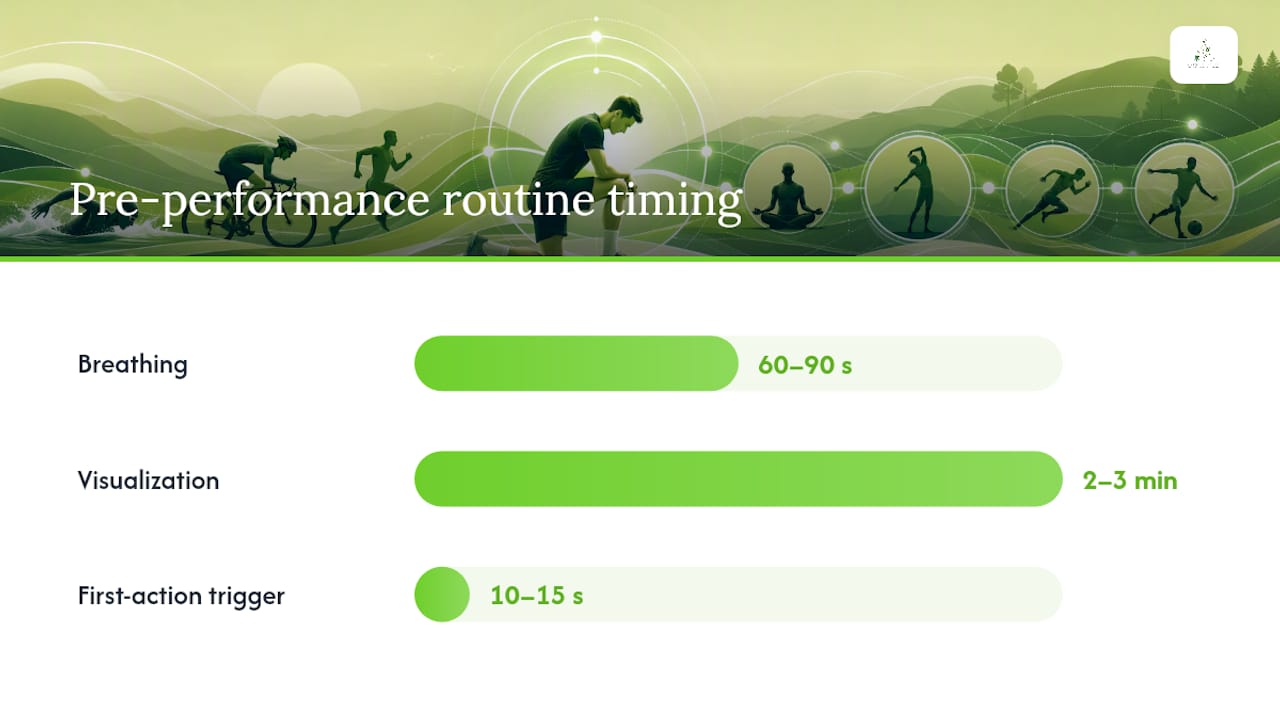
Step 1: Breathing (60 to 90 seconds). Four counts in, four counts hold, six counts out. This isn't relaxation for its own sake. It's regulating arousal down from spiked anxiety or up from flat lethargy into the functional middle zone flow requires.
Step 2: Visualization (2 to 3 minutes). Mentally rehearse the first specific action of competition, not the whole event. A tennis player visualizes the exact toss and swing of their first serve. A sprinter visualizes the exact feel of the first three steps out of the blocks. Specificity beats generality here every time.
Step 3: First-action cue (10 to 15 seconds, right before go time). A single word or physical trigger (a hand tap, a breath, a phrase like "smooth" or "now") that signals the transition from preparation into execution.
Before any of that, run a quick trigger checklist covering the conditions most likely to derail entry:
- Environment: Is the space familiar enough to reduce novelty-driven distraction?
- Equipment: Is gear checked and settled, removing a source of late distraction?
- Arousal: Does your energy feel activated but controlled, not flat or spiked?
- Focus cue: Is your first-action trigger set and rehearsed?
- Micro-goals: Do you have one specific, immediate target for the opening sequence?
Pro Tip: Sprint and power athletes generally need shorter, more intense versions of this routine (under two minutes total) since prolonged stillness can drop arousal too low. Endurance and precision athletes, golfers and archers especially, often benefit from the full five-minute version since their sports reward a calmer entry state. Reviewing subconscious mind research in athletics can help coaches understand why consistent pre-performance cues work at a deeper level than surface-level ritual.
Do Mindfulness and Meditation Actually Support Flow?
Short mindfulness practices, three to five minutes of breath or body-focused attention, build the same attentional stability that flow entry depends on, and they're far more practical for competition day than a 30-minute seated meditation session.
The mechanism is straightforward: mindfulness trains the ability to notice a wandering mind and return attention to a chosen focus without frustration. That's essentially the same skill an athlete needs when a bad call, a crowd reaction, or a stray thought about the scoreboard threatens to pull them out of flow mid-competition. Athletes who practice this skill regularly tend to recover from interruptions faster, which shows up directly in the recovery-time metric from the training framework above.
Visualization and cue rehearsal amplify these gains rather than replacing them. Combining a short mindfulness practice with mental rehearsal of the specific movement pattern about to be performed appears to prime both the attentional and motor systems at once, which is likely part of why the two techniques so often show up paired in applied mental performance protocols.
Longer meditation practice (15 to 20 minutes, several times a week) earns its place for athletes dealing with chronic stress, sleep disruption, or a pattern of anxiety that shows up across multiple areas of life, not just competition. For most competitive athletes managing a normal training and competition schedule, though, the short daily micro-practice delivers most of the attentional benefit without demanding a large time investment. Save the longer sessions for off-season or for genuine stress-management needs rather than treating them as mandatory daily maintenance.
Performance Neuro Training: An Advanced Option When Flow Stays Out of Reach
Some athletes do everything right, challenge-skill balance, clear goals, a solid pre-performance routine, structured attention training, and flow still won't stick. When that happens, the block is often nervous-system level rather than technique level: past injury, panic responses, or unresolved stress patterns that keep the body locked in a defensive state no amount of breathing drills can override on its own.
Some performance neurotraining programs work specifically at that layer. Certain proprietary protocols are designed to retrain nervous-system responses tied to anxiety, panic, and trauma held over from past injury or life stress, clearing the physiological noise that keeps athletes locked out of flow even when their mental skills are otherwise solid. It's built to complement the attention and recovery training covered earlier in this piece, not replace it. Attention training teaches the mind where to focus; nervous-system work addresses why the body sometimes refuses to cooperate no matter how well-aimed that focus is.
This approach tends to suit athletes carrying a specific post-injury fear response, competitors with a documented pattern of panic or freezing under pressure, or anyone who has run structured flow training conscientiously and still hits a wall the checklist can't explain. Some programs run through telehealth and are offered as 1:1 coaching, multi-week optimization programs, or team-based workshops, typically starting with an assessment to map the specific pattern before building a strategy around it. For athletes and coaches who want to see the full protocol laid out, the Alpha Imprinting program page walks through the assessment-to-strategy process in detail, including sport-specific applications for tennis and baseball athletes navigating similar performance blocks.
Training Flow as a Capacity, Not a Miracle
Most of what gets written about flow treats it like a secret door that swings open once an athlete finds the magic mindset. That framing sets people up to fail, because it makes flow sound binary: either you're in it or you're not, either you found the door or you're locked out. The research doesn't support that picture. Flow sits on a continuum, entry is gradual, and the r = 0.31 effect size from the 2021 meta-analysis should tell you something important: this is a real, moderate lever, not a magic multiplier that turns an average performance into a career best by itself.
What actually works looks less exciting than the highlight-reel version. It's tracking entry latency across a training block and noticing it drop from eight minutes to five. It's building resilience to interruption so a bad call doesn't cost you the rest of the set. It's treating a slightly faster recovery time after a missed rep as a genuine win worth logging, even though nobody will ever put it in a highlight reel.
Periodization matters here as much as it does for strength training. Flow capacity needs recovery blocks, not just relentless attention drills, or the nervous system starts treating every session like a grind instead of an opportunity. And flow is one contributor among several, sitting alongside conditioning, technical skill, and tactical prep. Treat it that way, and the training actually sticks.
— Paige
Sources
The evidence base behind this article draws from a 2021 systematic review and meta-analysis quantifying the flow–performance link, a Frontiers 2022 qualitative study on flow phases in elite athletes and musicians, applied guidance from the Association for Applied Sport Psychology, neuroscience context from the Flow Research Collective, and a recent intervention study testing flow training feasibility. For readers interested in how recovery and stress reduction intersect with performance states more broadly, this overview of exercise and stress reduction offers useful complementary context.
- Achieving Flow: An Exploratory Investigation of Elite College Athletes and Musicians
- Find Your Zone — Association for Applied Sport Psychology (AASP)
- Flow Research Collective: Neuroscience of human performance