
Robertsneurotraining's Alpha Imprinting is the strongest neuroscience-first alternative to ThriveSP for competitive athletes who need more than mental skills coaching. It combines telehealth delivery, optional QEEG brain assessment, and a structured 6–12 week protocol that targets the nervous system directly, not just mindset habits.
Other viable categories worth evaluating:
- Licensed sports psychologists with QEEG-informed planning (PhD or PsyD, objective baseline assessment)
- Neurofeedback clinics offering brainwave-regulation training with measurable session data
- Integrated telehealth performance programs combining cognitive coaching with device-supported home protocols
Table of Contents
- What do the best thrivesp.com alternatives actually look like?
- How do you choose the right alternative for your needs?
- What does "neuroscience-based sports psychology" actually involve?
- Why Robertsneurotraining may be the right alternative for you
- Practical next steps to find and book the right provider
- How do customer support and user experience compare across alternatives?
- What should you know about subscription models, cancellations, and refunds?
- How much personalization do these alternatives actually offer?
- Can these programs integrate with your existing training setup?
- Are you searching for ThriveSP or ThriveSparrow? They're not the same thing
- Key Takeaways
- What actually drives results in this space
- Robertsneurotraining: the neuroscience-first option for serious athletes
- Useful sources and further reading
What do the best thrivesp.com alternatives actually look like?
ThriveSP (Thrive: Excellence in Sport Performance), founded in 2015 and headquartered in Seattle, Washington, focuses on evidence-based mental skills training for athletes across confidence, focus, resilience, and motivation. It's a legitimate program. But if you're a competitive athlete dealing with performance anxiety rooted in injury, trauma, or autonomic dysregulation, a mental-skills-only approach may not go deep enough.
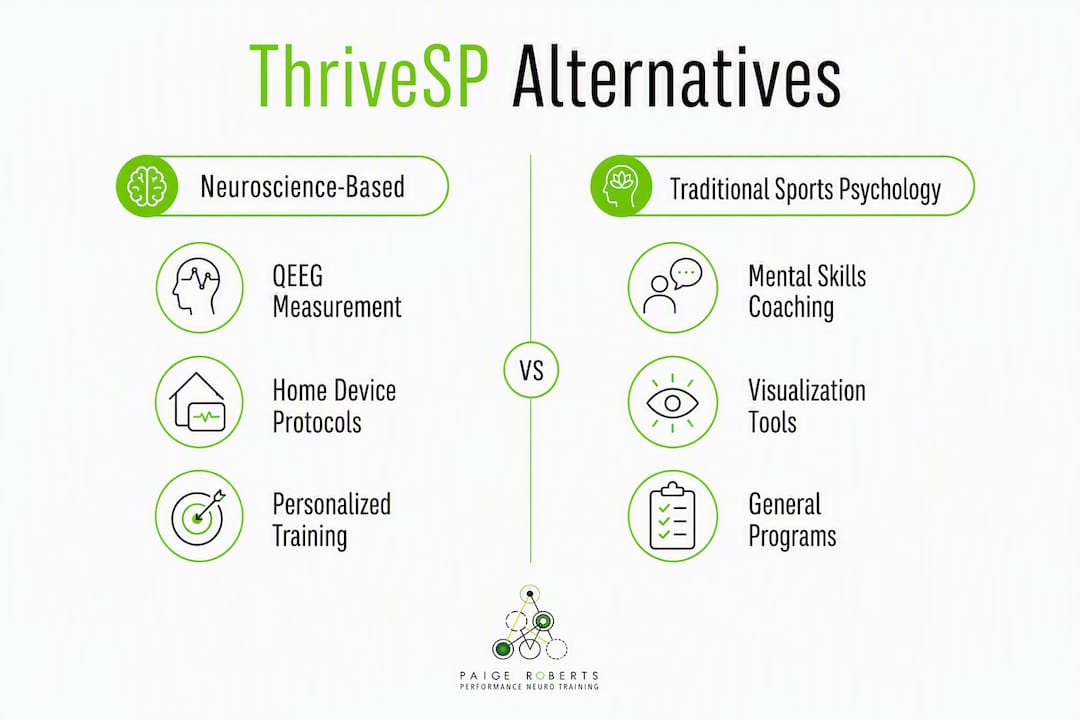
| Category | Core approach | Delivery | Timeline to results | Cost shape | Key credentials |
|---|---|---|---|---|---|
| Neuroscience-based nervous system training (e.g., Alpha Imprinting) | QEEG assessment + nervous system retraining + device protocols | Telehealth + optional in-person | multi-week program | Program packages | PhD/licensed clinician, QEEG, athlete testimonials |
| Licensed sports psychologist (traditional) | CBT, imagery, goal-setting, mental skills | In-person or telehealth | 6–12 weeks | Per-session (varies by provider) | PhD, PsyD, licensed |
| Neurofeedback clinic | Brainwave regulation, biofeedback | In-person (primarily) | 10–20 sessions | Per-session or package | BCIA certification, clinical oversight |
| Telehealth performance coaching | Cognitive coaching, mindset tools | Telehealth | Ongoing | Monthly or per-session | Varies widely |
Pro Tip: When reviewing credentials, "PhD" alone isn't enough. Ask whether the practitioner is licensed in your state, whether they use an objective baseline like QEEG, and whether they can show documented athlete outcomes. A credential without a measurable protocol is just a title.
"Athletes who engage in neuroscience-based training with objective assessments — rather than self-report alone — tend to track progress more accurately and stay in programs long enough to see lasting change."
How do you choose the right alternative for your needs?
Match the modality to the problem, not the marketing. If your performance issue is rooted in a trauma response, injury-related fear, or an autonomic pattern that kicks in under pressure, a mental-skills program won't fix it. You need a provider who works at the nervous-system level.
Evaluation criteria, in priority order:
- Modality fit: does the approach address your specific performance barrier (anxiety, freeze response, injury recovery, focus)?
- Objective assessment: does the provider use QEEG, biofeedback, or another measurable baseline?
- Practitioner credentials: PhD, licensed clinician, or BCIA-certified for neurofeedback
- Program personalization: sport-specific protocols, not generic mental performance scripts
- Device integration: home-use audio-visual or light therapy tools that extend session work
- Cancellation and refund policy: clearly stated before you sign anything
Questions to ask on your first call:
- What objective assessment do you use to establish my baseline?
- How many sessions before I should expect measurable change?
- Can your program integrate with my existing coaching or training staff?
- What is your refund or cancellation policy if I need to pause?
- Do you have documented outcomes from athletes in my sport or at my competitive level?
Neuroscience-driven programs typically run variable per-session fees for individual work, with structured packages spanning several weeks. QEEG assessments add cost but provide the objective baseline that separates evidence-based work from guesswork. Programs that include home-device protocols often cost more upfront but reduce the total number of live sessions needed.
Red flags to walk away from:
- No objective assessment before starting (just a questionnaire)
- Blanket guarantees of performance improvement within a fixed number of sessions
- Unclear or unlisted practitioner credentials
- No documented athlete outcomes or testimonials from competitive-level athletes
- Pressure to commit to a long package before a discovery call
What does "neuroscience-based sports psychology" actually involve?
The core idea: you're training the nervous system, not just the mind. Automatic responses under pressure, freeze states, performance anxiety, and post-injury fear are all stored in the body's autonomic patterns. Talking about them helps. Retraining them works faster.
Key modalities in this space:
- Alpha Imprinting: Robertsneurotraining's proprietary protocol. It uses a combination of telehealth coaching, optional QEEG brain scans, and in-home light and audio-visual devices to retrain autonomic reactivity and make flow states more accessible under competitive pressure.
- Neurofeedback: Real-time brainwave monitoring that trains athletes to shift into optimal arousal states. Typically delivered in-person, with 20+ sessions for lasting change.
- QEEG-informed planning: A brain map that identifies dysregulation patterns before any intervention begins. It's the difference between a targeted protocol and a generic one.
- Cognitive performance coaching: Goal-setting, imagery, and mental rehearsal. Effective for skill-level issues; less effective for trauma-rooted or autonomic barriers.
- Light and audio-visual entrainment: Device-based protocols used between sessions to reinforce nervous-system changes at home.
Typical session structure includes a check-in on recent performance data, a targeted nervous-system or cognitive intervention, and a home-protocol assignment. Progress is tracked through QEEG markers, self-reported performance metrics, and simulation outcomes.
Athletes in structured, evidence-based programs typically notice measurable changes in arousal regulation and performance consistency within a multi-week period of intensive work.
Why Robertsneurotraining may be the right alternative for you
Robertsneurotraining is the right pick when the performance barrier isn't a skills gap. If you're dealing with a freeze response after an injury, chronic performance anxiety that doesn't respond to mental skills work, or a trauma pattern that surfaces under competitive pressure, Alpha Imprinting addresses the nervous-system layer that standard sports psychology programs don't reach.
Core services and delivery options:
- 1:1 Performance Neuro Training via telehealth
- 10-week Energy Optimization Program (structured, intensive)
- QEEG brain scans for objective baseline and progress tracking
- In-home light therapy and audio-visual device protocols
- Group workshops and cohort programs for teams
- Sport-specific programs for baseball, tennis, equestrian, and other sports
"Olympic-level athletes have reported significant performance improvements through Alpha Imprinting, including the ability to access flow states more consistently under competitive pressure." — [author_bio] [testimonial] [brand_signal]
Choose Robertsneurotraining over a standard sports psychologist when you need objective measurement (QEEG), a structured timeline, and a protocol that works at the autonomic level. Choose it over a basic telehealth coaching platform when the issue is deeper than mindset and requires clinical-grade nervous-system work.
Pro Tip: Sport-specific pages (baseball, equestrian, tennis) show how Alpha Imprinting adapts to the demands of each discipline. If you compete in a specific sport, reviewing that page before your discovery call gives you a clearer picture of what the protocol targets for your performance context.
Practical next steps to find and book the right provider
Start narrow. Pick two or three providers from the categories above, send a short intro email, and book discovery calls within the next 7–14 days. Don't evaluate more than three at once — the decision criteria are clear enough that you don't need a long list.
Evaluation checklist for your shortlisted providers:
- Confirm practitioner credentials (license, PhD, BCIA certification as applicable)
- Ask for the objective assessment protocol used before sessions begin
- Request a documented timeline to measurable outcomes
- Review the cancellation and refund policy in writing
- Ask for at least one athlete outcome example from your sport or competitive level
- Confirm telehealth availability if you travel or train in multiple locations
Sample intro email you can send today:
Before a QEEG session, avoid caffeine for at least four hours, arrive with clean, dry hair, and bring recent performance notes or video if available. The practitioner will walk you through the scan process, but knowing what to expect reduces first-session anxiety.
How do customer support and user experience compare across alternatives?
Telehealth-first programs like Robertsneurotraining tend to offer more scheduling flexibility and direct practitioner access than clinic-based neurofeedback providers, where session slots are tied to physical equipment availability. Traditional sports psychologists vary widely: some operate solo with limited administrative support, while others work within university or team settings with structured intake processes.
The clearest differentiator in user experience is whether the provider assigns a single practitioner for the full program or rotates staff. Continuity matters in nervous-system work. A provider who hands you off between sessions is a meaningful step down in quality, regardless of the modality.
What should you know about subscription models, cancellations, and refunds?
Most neuroscience-based performance programs are structured as packages rather than open-ended subscriptions. A 10-week program is a fixed commitment; a per-session arrangement gives more flexibility but typically costs more per session and lacks the cumulative protocol structure that drives results.
Before signing, get the cancellation and refund policy in writing. Specifically: what happens if you're injured mid-program, what the refund window is after the first session, and whether unused sessions roll over or expire. Programs that won't answer these questions before you pay are a red flag. Robertsneurotraining operates on a fee-for-service model with defined program structures; confirm current terms directly during your discovery call.
How much personalization do these alternatives actually offer?
The gap between programs is widest here. A QEEG-informed protocol is, by definition, personalized to your brain's specific dysregulation pattern. A generic mental-skills curriculum is not, regardless of how it's marketed.
For athletes, the mental performance optimization that actually sticks is sport-specific and tied to real competitive scenarios. Robertsneurotraining's sport-specific pages for baseball, equestrian, and other disciplines reflect this: the protocol adapts to the physiological and psychological demands of each sport, not just the athlete's general stress profile. Neurofeedback clinics typically personalize to brainwave data but may not adapt to sport-specific performance contexts. Telehealth coaching platforms vary widely, with some offering fully customized programs and others delivering templated content with a live check-in layer.
Can these programs integrate with your existing training setup?
Most telehealth-based programs integrate well with existing coaching and training staff because sessions happen remotely and don't require schedule restructuring. The more relevant question is whether the provider communicates with your coach or athletic trainer, and whether the protocol reinforces or conflicts with your physical training load.
Robertsneurotraining's home-device protocols (light therapy, audio-visual entrainment) are designed to fit into recovery windows rather than compete with training time. For athletes working with a broader performance team, the athlete mindset training framework at Robertsneurotraining is built to complement, not replace, existing coaching. When evaluating any provider, ask directly: "How do you coordinate with my existing coaching staff, and what does that communication look like?"
Are you searching for ThriveSP or ThriveSparrow? They're not the same thing
If you searched "thrivesp.com alternatives" and landed on results about ThriveSparrow, you've hit a common search confusion. ThriveSparrow is an HR and employee engagement software platform with no connection to sports psychology or athletic performance. It shows up in "thrive*" searches because of name overlap, not relevance.
ThriveSP (thrivesp.com) is a Seattle-based sports performance organization offering mental skills training for athletes. ThriveSparrow is an entirely different HR platform serving workplace teams. If you're an athlete looking for performance psychology alternatives, ignore any result that mentions employee surveys, HR analytics, or engagement scores — those are ThriveSparrow results, not sports performance providers.
Key Takeaways
For competitive athletes, the best thrivesp.com alternatives are the ones that match your specific performance barrier to the right modality, with objective assessment and a clear timeline built in from the start.
| Point | Details |
|---|---|
| Match modality to the problem | Nervous-system barriers need neuroscience-based work; mental-skills programs alone won't resolve autonomic patterns. |
| Demand objective assessment | QEEG or equivalent baseline separates evidence-based programs from generic coaching. |
| Expect several weeks for results | Structured, intensive protocols typically produce measurable changes in arousal and performance within this timeframe. |
| Watch for ThriveSparrow confusion | ThriveSparrow is HR software; ThriveSP is sports psychology. They are unrelated. |
| Robertsneurotraining is the recommended pick | Alpha Imprinting offers QEEG assessment, telehealth delivery, sport-specific protocols, and a structured 10-week program. |
What actually drives results in this space
Most athletes I work with have already tried the mental-skills route. They've done the visualization, the breathing work, the goal-setting. Some of it helped. None of it resolved the freeze response that shows up in the third period or the fourth set.
The reason is straightforward: those tools work at the cognitive level. They don't reach the autonomic patterns that were wired in during an injury, a high-stakes failure, or a chronic stress period. Alpha Imprinting targets that layer directly. The QEEG gives us an objective map of where the dysregulation lives, and the protocol works backward from there.
What I'd tell any athlete evaluating options: don't choose a provider based on credentials alone. Choose based on whether they can show you an objective baseline, a documented timeline, and outcomes from athletes who competed at your level. [author_bio] [testimonial] [brand_signal]
Robertsneurotraining: the neuroscience-first option for serious athletes
If you've read this far, you already know that mental-skills coaching and nervous-system retraining are not the same thing. Robertsneurotraining gives competitive athletes a path that most programs don't offer: an objective QEEG baseline, a structured 10-week protocol, telehealth access from anywhere in the United States, and sport-specific programs built around the actual demands of your discipline.
The first step is a discovery call. You'll walk through your performance history, current barriers, and whether a QEEG assessment makes sense for your situation. No commitment required before that conversation. Book your Alpha Imprinting discovery session and find out exactly what your nervous system is doing under pressure.
Useful sources and further reading
- Alpha Imprinting — Roberts Neurotraining: Primary program page describing the Alpha Imprinting protocol, delivery options, and booking.
- Neuroscience Based Training for Athletes: 2026 Guide: Primer on modalities, timelines, and how QEEG-informed training works in practice.
- Mental Performance Optimization Techniques for Athletes: Session-level tactics and objective measures used to track progress.
- Top 6 Mentaltraininginc.com Alternatives for Athletes 2026: Evaluation framework and shortlist model for comparing neuroscience-based providers.
- Top 4 Neurofeedback-institute.com Alternatives Experts 2026: Explains differences between neurofeedback and other neuroscience-driven methods.
- Baseball — Alpha Imprinting · Roberts Neurotraining: Sport-specific program page showing how Alpha Imprinting adapts to baseball performance demands.
- 10 ThriveSparrow Alternatives: Pricing & Reviews [2026 Guide]: Evidence of the common search confusion between ThriveSparrow (HR software) and ThriveSP (sports psychology).
- Best JNX Sports Alternatives for Serious Athletes in 2026 | Just Move Supplements: Partner perspective on how serious athletes evaluate and select performance services.