
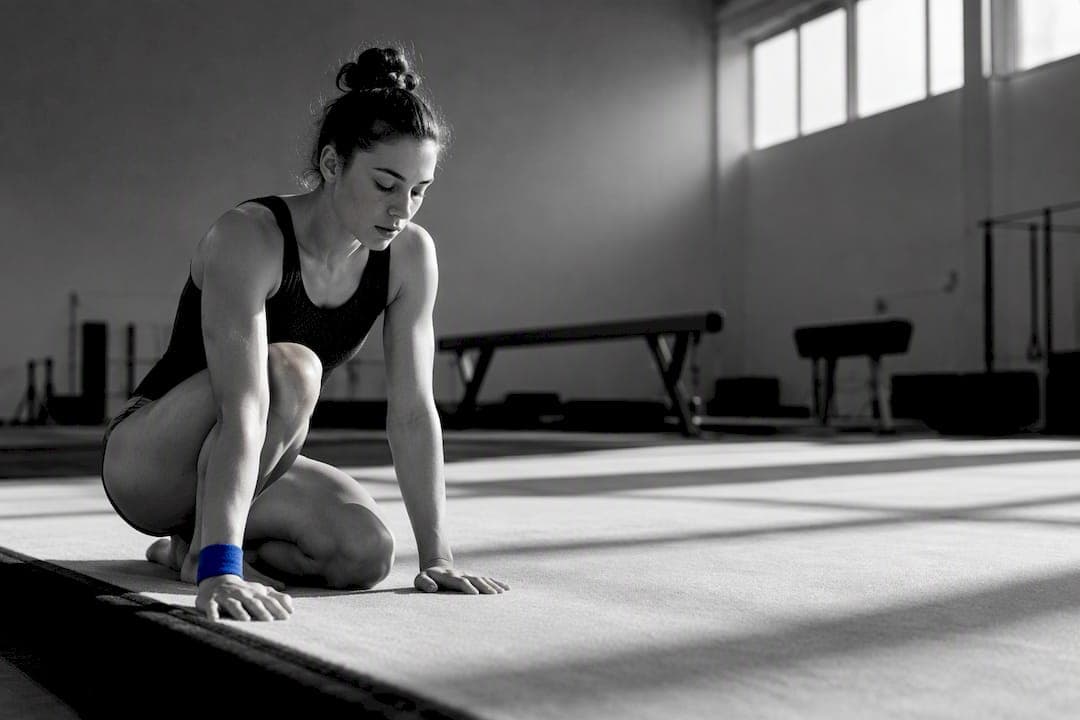
Stage fright in athletes is performance anxiety, a spike of fear and physical tension tied to being watched and judged while competing. It shows up at every level, from youth leagues to the Olympics, and it responds well to training. The fastest first step is learning a short physical regulation routine you can trigger on demand, paired with ongoing practice of sport-specific mental skills.
TL;DR:
- Relaxation techniques help reduce cognitive anxiety, while mindfulness-acceptance methods are more effective for managing physical tension and physiological responses.
- Athletes often experience triggers such as injury recoveries, media exposure, or environmental cues linked to past failures that amplify performance anxiety.
- Building and practicing a pre-competition routine using breathing exercises and mental anchors can improve self-regulation and focus under pressure.
- Severe or persistent anxiety symptoms that do not respond to self-regulation may require professional support from sport psychologists or neurofeedback specialists.
- Combining nervous-system regulation with mental skills training offers a comprehensive approach to reducing the automatic reactivity that causes stage fright in athletes.
Table of Contents
- How stage fright shows up in the body and mind
- Why competition triggers it: causes and sport-specific pressure points
- What the research says about which interventions actually work
- Building reliable pre-competition and in-game reset routines
- When performance anxiety needs professional support
- How nervous-system training complements mental skills work
- Why I think regulation and skill practice have to go together
- Getting specialist support from Roberts Neurotraining
- Sources
- FAQ
How stage fright shows up in the body and mind
Performance anxiety splits into two categories, and knowing which one you're dealing with changes what you should do about it. Somatic symptoms live in the body: a racing heart, nausea, shaking hands, and the fine-motor breakdown that turns a routine free throw or golf putt into a fight. Cognitive symptoms live in the head: your mind blanks mid-routine, self-talk turns catastrophic, and attention narrows so hard that you stop seeing the whole field and start fixating on one threat.
In sport, these symptoms have names. The yips, sudden and involuntary motor disruption in a previously automatic skill, and choking, a drop in performance under pressure despite the physical ability to succeed, are both downstream of this same anxiety response. Sport psychologists sometimes use structured tools like the CSAI-2 (Competitive State Anxiety Inventory-2) to separate cognitive worry from somatic arousal in an athlete's profile.
- Somatic: elevated heart rate, nausea, tremor, loss of fine motor control
- Cognitive: mental blanking, negative self-talk, overmonitoring your own movements, tunnel-vision attention
Why competition triggers it: causes and sport-specific pressure points
Stage fright is fundamentally a fear of judgment. Competing in front of others activates a social-evaluative threat response: your nervous system treats a crowd's attention the same way it treats physical danger, triggering fight-or-flight even though nothing is chasing you. That response narrows attention and can hijack memory, which is why athletes sometimes forget cues they've rehearsed hundreds of times.
Certain moments make this worse. Returning from injury adds fear of re-injury on top of performance pressure. Increased media coverage and personal-brand exposure raise the stakes of every mistake. And any situational cue tied to a past failure, a specific court, a rival, a scoreboard, can reactivate the same anxious pattern.
- Fear of judgment from coaches, fans, or opponents
- Pressure tied to identity or outcome, feeling like your worth rides on the result
- Injury comebacks and heightened public visibility
- Environmental cues linked to a previous poor performance
What the research says about which interventions actually work
The strongest available evidence comes from a Bayesian network meta-analysis of 46 trials, which found that Mindfulness-Acceptance-Commitment (MAC) training and relaxation-based methods produced relatively larger effects for reducing competitive anxiety, though the effects varied by athlete level and by whether the anxiety was mostly cognitive or somatic. Relaxation techniques tended to help cognitive anxiety more, while MAC showed a stronger edge for somatic anxiety.
Studies of psychological interventions show mindfulness and acceptance-based training among the most effective tools for competitive anxiety in a network meta-analysis of 46 trials. That means the intervention worth prioritizing depends partly on which symptoms you actually experience.
A separate systematic review and meta-analysis found that psychological skills training (PST), mindfulness and acceptance approaches, and imagery all produced moderate improvements in performance-relevant outcomes, though the effects grew less certain once lower-quality studies were removed. Subgroup analysis also suggests younger athletes and those in individual sports often see larger anxiety reductions from these interventions than others, which argues for tailoring the approach to the person rather than applying one template to everyone.
- Cognitive anxiety (worry, self-doubt): relaxation training and imagery tend to help more
- Somatic anxiety (physical tension, racing heart): MAC and biofeedback tend to help more
- Younger or individual-sport athletes: often show larger gains from structured PST
- Elite athletes: benefit from imagery and process-focused routines refined over years of practice
The consistent caveat across this research is heterogeneity: study designs, athlete populations, and anxiety measures vary enough that no single method is universally "best," as also discussed in how to improve performance speed and lap times. What holds up is the principle that skill practiced repeatedly beats a one-off tip read the night before a competition, a point echoed in broader coverage of mental training's effect on physical output.
Building reliable pre-competition and in-game reset routines
Sport psychologist Dr. Michael Gerson, in an Olympics, describes a framework called the five Rs for interrupting a pressure spiral: Recognize the anxious state, Release the physical tension, Refocus on a specific cue, Rehearse the next action mentally, and Respond by executing it. The point isn't to eliminate nerves. It's to have a practiced sequence that returns you to your task instead of the threat.
Two micro-resets worth training into muscle memory:
- The 3-second breath box. Inhale for 3 seconds, hold for 3, exhale for 3, hold for 3. Repeat once. It's short enough to use between plays or before a serve.
- The two-word anchor. Pick two words tied to your job on the field ("soft hands," "quiet feet") and say them internally the moment you notice anxious thoughts creeping in.
A brief pre-performance warm-up combining slow breathing with a mental run-through of your first move can help prime the nervous system before the first whistle. Building this into a routine works best on a timeline: spend the first week just noticing when anxiety spikes, weeks two and three rehearsing the breath box and anchor in low-stakes practice, week four adding them into scrimmages or practice matches, and week five testing them under simulated pressure, teammates watching, a clock running, something on the line. Track whether your resting heart rate drops more quickly and focus returns to task faster after the routine as personal ways to measure progress.
Pro Tip: Rehearse your reset in practice under mild pressure, not just at home in silence, because the skill has to work when your heart rate is already up.
For a longer breakdown of building state-management skills over time, see this guide to performance state management, and for the difference between breathing drills and broader mindfulness work, this comparison of breathwork and meditation is a useful next read.

When performance anxiety needs professional support
Most stage fright responds to practiced self-regulation and skill training, but some signs call for outside help. Watch for panic that doesn't ease with your usual routine, avoidance of competition altogether, a performance slump that persists across multiple events, or anxiety clearly rooted in a past injury or traumatic moment on the field.
Providers differ in approach. A sport psychologist typically works on the mental skills side: goal-setting, imagery, focus training. A CBT therapist targets the thought patterns feeding the anxiety. A MAC-trained coach blends mindfulness with commitment to values-based action. Biofeedback and neurofeedback practitioners work directly with physiological signals like heart rate variability or brainwave activity, and pooled research shows encouraging, though still heterogeneous, effects for mental health and performance outcomes from this approach.
- Panic or physical symptoms that don't resolve with breathing or grounding
- Avoiding competition, practice, or specific situations tied to past failure
- A performance decline that outlasts a single bad week
- Anxiety linked to a specific injury or traumatic event
Ask a prospective provider how they measure progress and how many sessions their typical athlete needs before seeing change; a primer on what mental performance coaching involves is a reasonable starting point for comparing options.
How nervous-system training complements mental skills work
Standard mental skills training teaches an athlete what to think and do under pressure. A complementary route works at the level of the nervous system itself, aiming to lower the automatic reactivity that produces the racing heart and mental blanking in the first place. A specialist sports psychology practice uses a protocol called Alpha Imprinting alongside QEEG brain scans and brainspotting to target the physiological patterns tied to panic, old injuries, and past stress that can resurface as performance anxiety.
Combining a nervous-system regulation protocol with repeated mental skills practice can help reduce autonomic reactivity while reinforcing the attentional anchors athletes rely on in competition.
Options in this space include the 12-Week Energy Optimization Program, individual QEEG Brain Scans, and Brainspotting for Sports sessions, each aimed at athletes whose anxiety has deeper roots than a single bad outing.
Why I think regulation and skill practice have to go together
Nerves aren't a character flaw. They're a trainable nervous-system pattern, and treating them only as a mindset problem misses half the picture. Practice your resets the way you practice free throws: often, under pressure, before you need them.
— Paige
Getting specialist support from Roberts Neurotraining
If your anxiety keeps resurfacing despite consistent mental skills practice, it may be worth addressing the nervous system directly rather than only the thoughts sitting on top of it. Specialist services work with athletes at every level through multi-week programs, brain scans, and group sessions, each designed to identify and retrain the physiological patterns behind panic, mental blocks, and performance slumps.
Sessions run over telehealth, so you can start wherever you train. Visit the Roberts Neurotraining services page to see current programs and book an initial consultation.
This article is general information, not a substitute for advice from a qualified doctor. Consult a qualified healthcare professional about your own circumstances before acting on anything here.
Sources
- The Effect of Different Psychological Interventions on Athletes' Competitive Anxiety: A Systematic Review and Bayesian Network Meta-Analysis
- Effects of Psychological Interventions to Enhance Athletic Performance: A Systematic Review and Meta-Analysis
- Meta-analysis of biofeedback and neurofeedback effects in athletes
- March Madness and the mind: Dr Michael Gerson on pressure, mistakes and the psychology of high-stakes sport
FAQ
What famous people get stage fright?
Performers, public speakers, and athletes across many fields have described stage fright, since it's a normal response to being watched and judged rather than a rare condition. It affects beginners and seasoned professionals alike, though experienced performers often have more practiced ways of managing it.
Which famous athletes have experienced performance anxiety?
Elite athletes across sports have publicly described pressure-related breakdowns, including the yips, and coverage of Olympic competitors shows that even top performers experience these episodes. Handled well, these moments can become part of an athlete's long-term development rather than a permanent setback.
Do professional athletes still get nervous?
Yes, nervousness before competition is common at every level, including among Olympic and professional athletes. What changes with experience is usually the presence of a practiced routine for managing it, not the absence of nerves themselves.
Is stage fright a mental illness?
Stage fright, or performance anxiety, is generally considered a situational stress response rather than a diagnosable mental illness. It can become clinically significant if it involves panic, persistent avoidance, or a lasting performance decline, in which case a licensed provider can help determine the right course of support.